Initiating Bonding: A Hands-On Approach
The commonly advised (a lot of common advice is problematic) “hands-off” or, “let the chin come to you” approach of initiating a relationship with a chinchilla can work great with chins who’ve come from a background of positive socialization with people. Unfortunately, many have not, and we often hear from thoroughly frustrated chinparents who’ve been applying the “hands-off” advice with a chin who’s had no real experience with people or who has come from a background of negative socialization due to previous environment or treatment.
Typically, the people who give the most online advice are not the same people who spend hours every day working with high-strung, oversensitive, or troubled chins, and that’s why these chins are so often overlooked, misunderstood or dismissed as the exception. “Just sit with your arm resting in the cage and wait for him to come to you” or “Ignore your new chin and let him settle in for the first few days, or a week or two” might sound ok to us because we’re not a small, powerless animal of prey, trapped in a cage and yet exposed and vulnerable, dreading and expecting the worst, feeling alone, terrified, bewildered.
Given that the human has his freedom and total control while the chin is caged and helpless, how is that arrangement supposed to motivate this small prey animal, especially one who’s just come out of a bad experience with people, or who has spent days, maybe months in the nerve-wracking environment of a pet store, to step up and make friends? …Really??
When a chin is fearful of interaction and handling, especially if he shrieks or acts intimidated and terrified, then he NEEDS TO BE HELD, to be calmed, soothed, and gently reassured. You wouldn’t turn your back on a crying, frightened child, right? Well, a terrified chinchilla is no different in this way. Walking away when your chin is feeling vulnerable and scared will only justify and intensify his fears, because in his eyes YOU, the one responsible for his welfare and happiness, have deliberately abandoned him in his despair.
When a chin acts out with anti-social behavior that is NOT proof that the chin is “bad” or that he dislikes his chinparent. Although it can be hard not to take it personally, don’t, because biting, urine spraying and other defense tactics are a cry for help when coming from a helpless prey animal. That is the only way they have to communicate the alarm, fear, frustration, or stress that they’re feeling, and they truly do not want to discourage or drive off the only person capable of making them feel safe, secure, and loved.
Fear and anxiety won’t magically resolve themselves, something needs to take place for those feelings to subside, for confidence and trust to grow in their place. Only the chinparent has the ability to make this happen because the chinparent is responsible for and in control of EVERYTHING that affects the chin: his whole environment, and every aspect of how he is treated and provided for.
For a chin to overcome his fears, adjust to his new environment, and learn to interact and bond in a positive, healthy way, the chinparent needs to:
- Without fail, be sure that the chin is provided with all the essentials (fresh, high-quality pellets and hay, distilled or filtered water, chew toys, a hideaway, etc., a safe wheel is also strongly recommended) so that he will come to realize that he can trust his chinparent to meet ALL his needs, ALL the time.
- Keep environmental stresses in check (TV during waking hours does a lot to relieve debilitating stress), because anti-social behavior (biting, urine-spraying) is often attributable to that.
- Be assertive and persistent (in a gentle, loving way of course, and sometimes it takes a LOT of patience and time- like weeks, even months) in reassuring the chin when he is afraid, helping him to feel confident that he is loved and valued, no matter what he does, no matter how he behaves.
Our advice about being “hands-on” (as detailed in First Contact Procedure) derives from our rescue experience working with unsocialized and anti-social chins from all adoption backgrounds, and from years of feedback from rescue workers and chinparents. We believe that being hands-on provides a positive foundation for building a relationship with a chin regardless of his former experience with people, whether negative, positive, or inexperienced. We also recommend covering cages because it has many benefits, including providing a sense of protection and security.
To understand why a behavioral approach succeeds or fails, it is necessary to understand the perspective of the one on the receiving end. Like all animals, the behaviors that chinchillas exhibit are chiefly instinctual, the result of nature’s programming. Animals are neither morally complex nor egotistically driven, they are motivated by simple instinct whose goal it is to survive, thrive and reproduce (NOTE: chinchillas do not “need” to be bred and we promote same-sex pairing in captivity due to issues with overpopulation and careless breeding. This reference relates to their instincts in nature).
On one level of existence, chinchillas are prey animals, humans are predators. Prey animals take their cue (how to act, what to expect, how to successfully “survive, thrive and reproduce”) from their environment, and especially from the dominant species in their environment (chinparent). In the wild, prey animals use their intelligence and cunning in a more defensive or reactionary way while predators (like humans) take a more dominant and assertive role: initiating action, setting the pace, establishing expectations.
This means that instinctually speaking, a chinchilla is inclined to expect the more dominant species in his environment to make the first move, to confidently initiate the relationship, to welcome and reassure him and show him what to expect. This instinctual predisposition is reinforced by the fact that in captivity, our caged pets are in a position of submission and we are in a position of dominance. In their eyes they are completely at our mercy so again, this makes it OUR, the chinparent’s, responsibility to make the first move toward bonding; they can’t know what our intentions are unless we show them by being kind, reassuring, comforting and loving. Unless a chin has a background of positive socialization with people in order to perceive things differently, in order to feel assertive and confident in initiating the relationship, then the expectations of a hands-off approach are rather absurd.
What happens when the chin is ignored so he can “settle in,” or when the new chinparent acts tentative or afraid to pick him up, catch or handle him? To an animal of prey, such wary, withholding behavior on the part of the dominant species creates an atmosphere of fear, distrust, and uncertainty which at its very worst can cause the chin to succumb to acute shock (not a common problem, but it can happen). When a frightened new chin is ignored he may also act out with anti-social (biting, urine spraying) behavior, because in his eyes the chinparent who was supposed to be there when he was afraid, who was supposed to offer comfort and security, has betrayed him.
The confusion resulting from the reverse role-playing of the hands-off approach can wreak havoc on a chinparent’s relationship with their new chin. With a hands-on approach (as detailed in First Contact Procedure), the initiative, the responsibility for establishing a bond is put where the chin instinctively expects it to be, squarely on the shoulders of the chinparent. And when the chinparent assumes the role of initiating bonding and sets positive expectations, then the chin is given a definite framework within which to interact, which helps to alleviate his fears (fear of the unknown, of neglect, abandonment or mistreatment) and reassure him that he can put faith and trust in his chinparent and expect the best from his new situation.
First Contact Procedure
Initiating Bonding: A Hands-On Approach should be read prior to this section.
Firstly, don’t expect “instant” bonding and total control over your chin. Establishing a real relationship with a chinchilla, one of mutual trust and understanding, can take weeks, even months of TIME and PATIENCE on the part of the chinparent because chinchillas are highly intelligent, complex animals. Once you have established a bond of affection and trust, then the chin will usually become more receptive to your direction, but don’t expect absolute compliance and obedience because by nature chins tend to be spirited, willful and to like things on their terms. As someone once suggested to us in perhaps overly simplistic terms, it can be more like relating to a cat than a dog.
It’s important to understand that “a hands-on approach” is NOT the same as forcing your attention on your new pet in obnoxious and overbearing ways. Ambushing him with your attentions, constantly prying and never allowing him a moment’s peace can be just as frightening as withholding attention altogether, there is a middle ground and THAT is what we’re advocating here by a hands-on approach: giving appropriate attention that is gentle, soothing, calming, caring. It’s up to you, the chinparent, to be sensitive to your chin’s needs and to determine if he’s frightened and needs reassurance or if he’s feeling fine and just needs some time to himself, to be left alone for awhile.
When a chin is new to an environment, he needs to be welcomed by the dominant species in that environment (chinparent) with positive reassurance that this is friendly territory where he will be valued and respected. This article was originally written after hearing from several distraught chinparents who had been abstaining from interacting with, picking up or holding their chinchilla because they were led to believe the chin should be ignored and allowed to “settle in,” that the chin would decide when he was ready to bond with them and would make the first move. Clearly, no one notified the chin… and after waiting for days, weeks or months, if their chin hadn’t succumbed to acute shock (not a common problem but it can happen, especially with ranch chinchillas) and died, then it had shied away from them, become a fearful bundle of nerves, begun fur biting or even developed anti-social (biting, urine-spraying) habits out of sheer stress and frustration.
A hands-on approach is simple:
After you get your new chin home and give him about an hour to look around his new cage and get acquainted with his surroundings, then gently pick him up and find a quiet place where you can watch TV or listen to music and hold him for a while, sitting down, for at least five or ten minutes. With a loving touch and genuine concern for his comfort and happiness, speak to him in a soothing tone, tell him he’s a good boy, and be positive, calm, gentle, and reassuring.
Then find a way or relating that your chin seems receptive to, for instance: kiss (dry kiss!) his forehead, his paws, his cheek (again, whatever he seems to appreciate, find your communication groove), let him snuggle into or under your shirt, under a lap blanket or in the crook of your arm (snuggling under something is comforting and soothing, they hide in crevices and burrows in the wild). Be receptive to what your chin likes- find out how YOUR particular chin wants to be related to, as one rescue we work with put it, this calming and bonding time is essentially “Holding Therapy.”
Most chins don’t like to be petted in strokes, see this description of chin scratches and use that instead, all the while speaking soothingly to him. Be aware that some chinchillas react to human breath as if they’re being bombarded by another animal’s natural defenses. That is, they think that humans use breath the same way that another chin sprays urine, the way a porcupine uses its quills or a squid shoots ink; human breath can be overwhelming, repulsive and even threatening, especially if a chin is not accustomed to interaction with people. It can take time for a chin to realize that our breath is not intended to offend.
Take out your new chin and bond with him like this at least once daily, during his evening waking hours, for about five or ten minutes at a time or for longer periods of time or more frequently if he appears receptive. The First Contact Procedure should develop into out-of-cage exercise and playtime bonding when the chin is ready to explore his play area. Once he’s confident (and depending on his history it may take weeks, even months and a lot of time and patience for him to get confident) with you and his situation, then it’s fine to allow him to take the initiative and come to you.
To encourage him to take the initiative, put both your hands out, palms up(it’s the opposite of how we hold our hands to catch them, and thus it’s a gesture of friendliness rather than dominance), in front of the cage and wait for him to walk out onto your hands, or just hold the cage door open and let him come out to you. Not all chins will be receptive to this, what is important is that you extended the invitation, not whether or not the chin took it, and don’t just try this once and give up, not every chin may get the idea the first time.
Allowing your chin to take the initiative is empowering and therefore good for him and your relationship with him, but he may need time to work up to that. Also, don’t be surprised if your chin needs to be caught and taken to the playroom for exercise, this is typical and a chin’s reluctance to be picked up should NOT be misconstrued as disinterest in out-of-cage playtime!
The intent of a hands-on approach is to reassure your chin, to put him at ease and to encourage confidence and reciprocal trust and bonding. When you and your chinchilla find your communication groove, you’ll know it and then this initial bonding approach will no longer be necessary, you’ll have out-of-cage exercise and playtime bonding together, instead.
While becoming acquainted with your chin, be sure that all his essential needs are being met, including his need for a setup that provides some quiet and solitude (away from prying pets, excessive traffic) during daytime sleeping hours, this is essential to his health and a successful adjustment. We also highly recommend TV for chins during their nocturnal waking hours, it is extremely helpful in getting them to desensitize somewhat, to adjust to the hustle and bustle of the household all from the safety and comfort of their cage.
It may not be smooth sailing at first, but your chinchilla needs you to reach out with affection and understanding and eventually he will come around, so be gentle but persistent in comforting and reassuring him. Don’t let a “gruffer” or a “barker” dissuade you from handling him, those are the ones most in need of positive attention and they’re usually not biters, they’re usually the ones that are “all bark and no bite.” A good guideline is, if the chin is frightened (including those chins that go berserk at the prospect of being picked up, caught or held), then hold, snuggle and reassure him, but when he’s got gusto and confidence, let him go, and he’ll come back to you.
If you have taken in a chin that needs some medical care, like tending to a superficial wound our callouses and the chin is resistant to treatment, don’t withhold medical attention at this point for fear of stressing him out. In fact, as we advised chinparents in one case where a couple of chins needed treatment for Bumblefoot: “It’s your stand-offishness and temerity that is actually making it look like you ARE something to be feared and avoided. You need to catch and hold them and talk softly to them and persist with moisturizing their feet until the callouses/cuts heal. Do it for their own good and it’s not excessive or stressful once they learn that you are in charge AND that they have nothing to fear from that. No, you won’t be giving them flashbacks to what they were put through before, by letting them misbehave you’re actually reinforcing their insecurity because you’re not in control. When they test their boundaries and there seem to be none, they keep testing, they need boundaries to feel secure, much like very young children.”
A new chin needs at least a week to get acquainted with you before being introduced to another chin. They need to be firmly grounded in a bond of trust with you, to know that you won’t let harm come to them, to know that you have their best interests at heart. It’s fundamental to a chin’s confidence and even his will to live to know that, also, introductions should never be rushed or forced to satisfy the chinparent’s impatience, this can and has resulted in chinchilla injuries and deaths.
Relating To Your Chinchilla
As stated in Critical Points: Although they appear cute and cuddly, chinchillas, in general, are not sedentary lap pets who will sit still and welcome loads of holding and cuddling. They are usually sociable and enjoy interacting with people, but they like to be on the move: exploring, energetic, playful. While some pets will accept being dominated and controlled by their owner, chinchillas really do not. They prefer to have things on their terms: chinchillas have a keenly intelligent, curious, and independent nature with a mind and will of their own. Chins need to be RELATED TO as companions rather than treated as mere pets, and it takes someone with maturity and intelligence, emotional as well as psychological, to truly appreciate them.
Chin Scratches or Grooming
Most chins don’t like to be petted in strokes the way we would a dog or a cat. Instead, rub the tummy, under the chin, along the jawline, behind the ears or on the forehead in a circular, massaging motion. Approach your chin palms-up to give scratches, this way he’ll know he isn’t getting picked up, and use key words first to communicate intent, for example, we say, “scratch-scratch, scratch-scratch” a few times and they come to their cage door or let us approach during playtime to get their scratches. If you want to hold your chin on your lap for a little while before letting him out to run or before putting him back in his cage, by giving chin scratches you’ll entice him to pause for a few moments of bliss.
It is typical for chins to gruff in response to chin scratches. They guide each other during grooming sessions as well, making little chirping or gruffing sounds to guide their groomer’s technique. A little gruff means “not quite right, you’re almost there,” the irritated gruff means you’re quite off and short barks means they’ve had enough. Short barks when you initially approach can mean they’re not in the mood for chin scratches, but sometimes it’s a bluff and they’re won over once you start. It takes time and requires empathy and awareness to discern what your chin’s sounds mean, exactly what he’s trying to tell you, and individuals do vary somewhat in their communication sounds. Watch both your chin’s body language and sound variation while you’re grooming him and this will help guide you. Once your chin is being happily scratched he’ll be quiet and completely absorbed in your perfected technique.
Be aware that chins do nibble and this should not be reacted to adversely, they nibble each other while grooming and they may also groom their chinparent (knuckes, fingers, callouses, beard stubble, eyebrows, etc.) in response to chin scratches or just to express their affection and regard. A chin who is really enjoying his tummy rub will pull your hand in closer to show how much he likes it, and then nibble your knuckles gently, grooming you in appreciative reciprocation. If the chin becomes a bit too rough with his nibbling, then a simple admonishment like, “gentle, honey, gentle” and pulling your hand back a little will deter him, communicating the do’s and don’ts of how you like to be groomed without violating your moment of bonding.
Related Video:
Playtime Bonding
The best time to bond with your chinchilla is during out-of-cage exercise time or playtime. Chin scratches while in the cage and some cuddling when handling are great too, and some chins like to take a ride on their chinparent’s shoulder. But chins are free spirits that love to run and play and being there to interact with them while they enjoy their out-of-cage freedom is the ultimate chinparent experience.
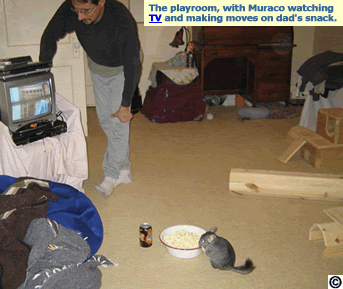
We use keywords to let our chins know when it’s playtime (“playtime,” repeated several times while getting them out of their cage and taking them to the playroom) and when playtime is over, to let them know that it’s time to be caught and returned to their cage (“getcha,” repeated several time while we catch and return them to their cage). When chins know what to expect it allows them to relax and enjoy themselves the rest of the time, they can act natural without being wary of being caught.
Even though the playroom should be sufficiently chin-proofed, if your chin happens to get into something he shouldn’t, snap your fingers or clap your hands once or twice and say “no” in a firm, not loud or frightening, manner. Use this tactic sparingly or its effect will diminish.
When your chin is running about, let him lead and take the initiative in coming to you, his curiosity will eventually lead him to do so unless he’s new and hasn’t been through First Contact Procedure. By allowing him to approach you during playtime, on his terms, you will be establishing a balance of respect in the relationship. Allow him to come up and investigate, jump off of, climb on you, etc., and don’t make a grab for him or try to handle him, just let him have his fun. Of course, it’s fine to reach out to him palms up (it’s the opposite of how we hold our hands to catch them, and thus it’s a gesture of friendliness rather than dominance) to do the affectionate things like give him a rub on the tummy or chin scratches under the chin, behind the ears or on the forehead. When your chin realizes that the playroom is HIS domain where interaction is on HIS terms, it will instill a sense of confidence and security in him and reinforce his trust in you.
Chinchillas are very perceptive, naturally curious and affectionate, they groom each other by gently nibbling and when they’re comfortable with you they’ll nibble at your hand, perch on your head, take flying leaps from your shoulder and run across any book or handheld device you may be engrossed in. Several of our chins have expressed an interest in our laptop, watching us use the graphics program and putting their paw on the keyboard periodically to ensure their input counts. Chins are amazing to watch at play, they sometimes ricochet off things to gain height while they race about, like springing off the wall to jump as high as the top of the door frame. They love stairs, a ladder in the playroom works well too, it gives them an advantageous lookout point.
The more active, wild, and crazy a chin is, the happier he is. The ultimate expressions of chinchilla joy and happiness include: “wall surfing” (bouncing off walls) and the mid-air jump and twitch, sometimes called “popcorning” but better referred to as a “happy dance.”
Catching and Handling Your Chinchilla
A person who is seriously intimidated by the prospect of catching and picking up their chin, who is alarmed, frightened or downright “freaked out” by their chin’s quick movements and high energy, should seriously question whether having a chinchilla for a pet is the right thing for them. Some people don’t realize until they’ve already brought a chin home that they have a rodent phobia altogether. At that point it is better to be honest about the predicament and rehome the chin rather than stick him in a remote corner of the house where he’ll be ignored and neglected. Trying to get around the “problem” of catching your chin by denying him proper exercise in a large room (about 12’x12′ or more), or only allowing him out for petting sessions is unacceptable treatment that can make some chins hostile in response to having their freedom so tightly controlled and limited.
MYTH: It’s totally unrealistic, particularly in the beginning of your relationship, to expect your chin to come bouncing up to his cage door on cue, to stand perfectly still and wait for you whenever you want to catch him, or to come and go on command. People who boast these claims have either adopted an unusually well socialized or passive and obedient chin, or they’ve spent a lot of time working with their chin (establishing a bond of trust, demonstrating expectations) to get him to that point.
Of course, once a positive rapport has been established between the chinparent and their chin, then the chin will usually become more responsive to their chinparent’s coaching, much like a child who is eager to please. For instance, all our chins come forward to give kisses through the cage mesh or to get chin scratches or a tummy rub when we put our hand into their cage, these are signs that we’ve established a positive rapport. But don’t expect a high degree of control over your chin because by nature they tend to be spirited and independent, with a mind and will of their own, they’re not inclined to docile obedience.
It is the chinchilla’s instinct as an animal of prey that makes them want to avoid capture, and this is why they can be difficult and exasperating to catch and pick up.
Not cooperating when it’s time to be picked up for playtime or when it’s time to go back to their cage when playtime is over is not a sign that the chin is defective, that he never wants to leave his cage or that he doesn’t like his chinparent. Even chins who enjoy some holding and cuddling (chins tend to get more sedentary as they age) still tend to resist the process of being caught and picked up, they’d rather run free: exploring, jumping, kicking off walls, just having fun.
Strong resistance to being caught or picked up should not be misread as a sign that the chin wants to be completely left alone. A chin that is not allowed to leave his cage will justifiably feel afraid and punished and may attempt to convey those feelings by acting out at his chinparent with anti-social (urine-spraying, biting) behavior. Chins NEED out-of-cage exercise and playtime bonding, the chinparent should EXPECT to have to catch their chin when he’s in his cage in order to get him out, and once he’s out, to catch him to return him to his cage. This is NORMAL and it will not traumatize the chin (if done correctly, as described later in this article) or make him dislike you, he simply needs the chance to become accustomed to the routine.
NOTE: Do not use a live trap, a fish net or even a butterfly net to catch your chin. Such measures are extreme, unnecessary and potentially dangerous. If a net rim descends on the thin, outstretched leg bone of a chin darting about, it can easily break his leg. In the wild chinchillas are preyed upon by owls and even at this point of domestication it is unnerving to have an object continually pouncing on them from overhead. Using nets and live traps to catch your chin will definitely traumatize him and damage the bond of trust you have, potentially making him react with anti-social behavior as a defense against this perceived aggression.
If your chinchilla is in his cage as opposed to running around the playroom, then catching and picking him up will be relatively easy. A well-socialized chin might be willing to come out on his own if you offer him your shoulder to perch on or if you hold your hands together in front of the cage door, palms up.
This is the opposite of how our hands are positioned when we try to catch them, palms down, and chins seem to recognize this difference and perceive the palms up gesture as a friendly invitation to come. If you always begin by extending the offer of your shoulder or hands palms up, the chin may eventually catch on and accept this way of being picked up. But don’t be surprised if he chooses to decline or if once he’s caught on and seems to like it, if he doesn’t always accept the invitation.
If the chin refuses the shoulder or hands palms up but he needs to be picked up for daily out-of-cage exercise and playtime bonding, persist in picking him up anyway and once he sees the playroom, you’ll see his attitude change from ornery reluctance to joyful enthusiasm. If your chin sprays urine or attempts to bite, see Initiating Bonding: A Hands-On Approach. If for some reason your chin is exhibiting anti-social behavior but needs to be picked up urgently, say if he’s hurt and requires immediate veterinary attention, just put on gloves (for biters) and proceed with the instructions detailed below.
Do not act afraid to pick up your chin! Erratic, apprehensive or wary behavior on the part of the chinparent will be perceived by the chin because they are very attuned to the behavior of the dominant species (chinparent) in their environment. If your chin gets the idea that you’re afraid to pick him up or uncertain about how to handle him, he’ll sense something’s wrong, that perhaps his chinparent is careless and unreliable, and once a chin thinks that he may become truly difficult to deal with because, much like small children, chins test their limits because they need to know that you’re in charge (in a fair, kind and benevolent way), it makes them feel safe.
Always pick up your chinchilla with a confident, certain manner. If he is frightened, made nervous or caught by surprise, he may release fur in the spots where he’s touched or where his fur is touched by other things that he bumps into in the course of his escape. Don’t let slipped fur deter you from picking up the chin, just proceed carefully and gently. The phenomenon of “fur slipping” is described in detail in the hyperlinked article but suffice to say here that this is a voluntary defense reaction on the chinchilla’s part, it will not hurt the chin and his fur will regrow.
There are two basic ways to pick up a chinchilla, “Base of the Tail” and “Scooping Up.” As you approach, speak a key word in a soothing tone so that the chin can associate that with being picked up. Establishing expectations makes the routine recognizeable and less stressful.
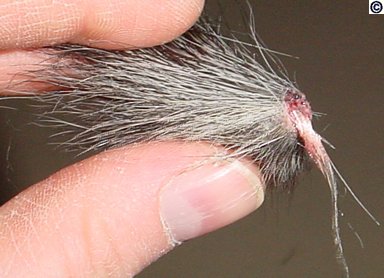
The “Base of the Tail” approach can be used on a chin that’s in motion or stationary. The chinparent must firmly grasp the BASE of the tail, the part where it meets the body, with one hand. Do not grab and hold onto the tail’s END, it CAN break off! This is not a “defense mechanism,” it WON’T grow back (although fur will regrow on the stump), it will bleed, it IS painful and the reason it snaps off is simply that that thin, fragile strip of fur and flesh cannot sustain the tension caused by the chin throwing his whole body weight in the opposite direction of your grip. If the chin starts yanking and struggling before you have a SOLID grip on the BASE of his tail, simply let go and try again.

Once you have the base of the tail gripped securely in one hand, immediately slide your other hand under the chin’s body for support and then quickly and gently draw him toward you. Hold him against your chest and be sure that his feet are supported at all times, never dangling. Chins also enjoy traveling about while perched on their chinparent’s shoulder, this can be encouraged by holding him up to the shoulder to see if he’s interested.
Picking up a chin by “Scooping Up” should only be attempted when the chin is stationary and unlikely to move suddenly. It’s a natural reaction to tighten one’s grip under those circumstances and that can easily bruise ribs or cause other serious internal injuries. If the chin is stationary, as when he’s being lifted out of a carrier, then he can be scooped up by placing one hand under his middle while simultaneously sliding the other hand under his posterior for support before drawing him to you.
Once the chin has been picked up and is being held, it is VERY IMPORTANT for the chinparent to give positive reinforcement so that the chin will make a positive association with the routine.
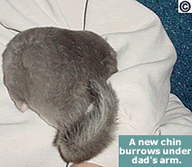
Positive reinforcement can be accomplished by holding the chin for a little bit and talking in kind, reassuring tones, and giving him “chin scratches,” as described earlier in this article. If the chin is acting frantic it will help calm him to gently cover his eyes with your hand or let him burrow under your arm so that he can feel he’s tucked somewhere safe. Give the chin comfort and reassurance but do not release him until he is calm, otherwise he’ll learn that going berserk is his ticket to never being handled. Frightened, frantic chins will stop acting that way (it may take a while, even months) if they learn what to expect because they are ALWAYS given positive reinforcement when picked up, ALWAYS loved and doted on, comforted and reassured, and only released when they are calm.
Be aware that chinchillas with a particularly thick, heavy coat usually cannot take being held for very long because it makes them too hot, especially during warm weather. Try holding your super-furry guy or gal when the room temperature is closer to 60°F than 70°F.
When the chin has been out playing and must be returned to his cage, he will most likely need to be chased to be caught and returned. Some people have luck calling their chin by name, giving a command or bribing them back to their cage with a treat, however, these methods are not always reliable and with regard to the latter, giving sugary treats such as raisins around playtime (an hour before or after) can cause bloodsugar-related seizures.
We’ve worked with literally hundreds of chinchillas from all backgrounds, including rescue and ranch chins that have needed socializing (because they lack experience with people) or behavioral rehabiliation (because they have had negative experiences with people), and from having our fair share of chasing these chins in order to catch them, we have learned for certain that it’s not a question of whether or not a chin should be chased, but rather it’s a matter of HOW the chasing is done. When done right, chasing is not a big deal and it will not traumatize the chin or cause him to distrust his chinparent.
When it’s time for the chin to go back to his cage and he needs to be caught, use cunning, not speed, to catch him.
Outsmart him by heading him off or anticipating his move so that he can be caught quickly and efficiently. What you should NOT do: run (this is DANGEROUS, you may not be able to stop in time to avoid an accident), shout, make loud exclamations, set up road blocks, move furniture (he’ll run into them head-first) or gesture wildly and suddenly.
Instead, approach with deliberate, calculated, swift action. At all times, the chinparent must be in charge of the situation and it must remain absolutely safe and under control. Stop and rest immediately if the chin appears totally panicked, or if he can’t be caught after about five minutes, so that you both can catch your breath and regroup.
When the chin is caught, no matter how obnoxious or uncooperative he was in the process, never reprimand or display frustration or anger, only give positive reinforcement as described previously. Eventually, once there is an established bond of affection, trust, and mutual respect between you and your chinchilla.
Related Video: