Two Studies Of The Wild Chinchilla Diet, And Plant Photos
To our knowledge, these are the only two studies of the wild chinchilla diet, but there may be more in Spanish that we don’t have ready access to. The plant photos are contained in the second, 1983, study.
2002: Seasonal food habits of the endangered long-tailed chinchilla (Chinchilla lanigera): the effect of precipitation
Full article: .pdf
Written for: Mammalian Biology 67 (2002) 167-175 by A. Cortés, E. Miranda,
and J. E. Jiménez Departamento de Biologia, Unversidad de La Serena, La Serena
and Departamento de Ciencias Basicas, Universidad de Los Lagos, Osorno, Chile
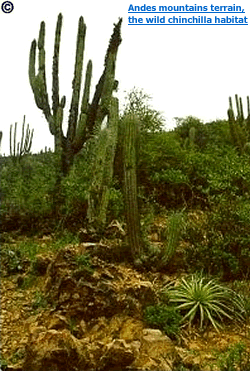
Quotes from the article: “Chinchillas are folivorous, using a feeding pattern of a generalist species. The opportunistic feeding behavior of chinchillas may be an adaptation to the harsh conditions and high variability in food availability triggered by fluctuations in rainfall among years in arid north-central Chile.”
“Food habits of chinchillas are poorly known. Accounts on their diet have been qualitative and non-rigorous (Mohlis 1983). Based on the analysis of feces collected in the Chinchilla National Reserve in north-central Chile, Serra (1979) first reported the chinchilla diet quantitatively. Combining information from 3 years, she found that chinchillas had a diverse diet, fed mostly on shrub leaves and that species composition in the diet varied considerably among seasons.”
“More recently, Jiménez (1990) estimated the diet of the same population using cafeteria tests and fecal analysis. Interestingly, he found that when offered fresh and dead leaves of several plant species, chinchillas preferred the dead and dried leaves, mainly from herb species. Chinchillas showed no interest in seeds and pods of native plants. According to Jiménez (1990), wild chinchillas feed on up to 24 plant species, mainly herbs, and their diet changes substantially between sites and during the year.”
“The dietary analysis of chinchilla based on the contents of feces indicates that the different plant life forms eaten varied markedly among seasons and between years. Overall, fibers made up most (>66%) of the diet in both years and in all seasons. These fibrous items are extremely difficult to identify and may correspond to highly lignified plant parts such as bark and woody stems of shrubs and of the succulent agave-like bromeliad Puya berteroniana. Herbs and shrubs followed in importance in the chinchilla diet. Identified succulents made up only a small fraction of the chinchilla diet, and were eaten in a non-predictable way throughout the two years. The same was true for seeds, the least represented food category in the diet.”
“Based on the above analysis, we conclude that chinchilla is a generalist and opportunist herbivorous rodent, incorporating herbaceous plants into its diets when available. This is seen as a dietary adaption to an ecosystem this is highly variable in rainfall and thus primary production, a characteristic of the arid shrublands of north-central Chile.”
1983: Chart of plants consumed by the wild Chinchilla lanigera, based on fecal studies
By Mohlis, C. (1983) Informacion Preliminar Sobre La Conservacion Y Manejo De La Chinchilla Silvestre En Chile Boletin Tecnico No.3, Santiago. Corporation Nacional Forestral, Santiago. (Preliminary Information on the Conservation and Management of Wild Chinchilla in Chile. Management Technique 3. Ministry of Agriculture. National Forestry Corporation Bulletin Tech No. 3). Translations Referenced: convenioandresbello.org, infochinchillas.com, wildchinchillas.org
Select the hyperlinked scientific names to view photo examples of the plant. Being horticulturalists by hobby, we chose to be very conservative and the only link to those photos that we’re certain are accurate. Go to infochinchillas.com to see photos in plain view on one page. Note that a common name may refer to more than one type of plant, for accuracy a plant must be identified by its complete scientific name. The Puya berteroniana plant serves as a shelter, a food staple, and a water source for chinchillas in the wild.
| Scientific Name | Common Name | Part of Plant Consumed | Season It Was Consumed |
|---|---|---|---|
| Bridgesia incisaefolia | Rumpiato | Seeds | Fall |
| Calandrinia grandiflora | Renilla | Leaves | Spring, Summer |
| Cordia decandra | Carbonillo | Seeds | Winter, Summer, Fall |
| Ephedra andina | Pingo pingo | Stems | Winter, Spring, Summer, Fall |
| Flourensia thurifera | Maravilla del Campo or Incienso | Leaves | Summer, Fall |
| Gutierrezia paniculata | Pichanilla | Leaves | Winter, Summer, Fall |
| Leucocoryne purpurea | Cebellín | Leaves and roots | Winter, Spring |
| Nassella chilensis | Coironcillo | Stem, leaves and seeds | Winter, Spring, Summer, Fall |
| Notholaena mollis | Doradilla | Leaves | Summer, Fall |
| Opuntia spp. | Gratitos | Roots | Winter, Fall |
| Proustia baccharoides | Olivillo del norte | Stem and leaves | Winter, Fall |
| Puya berteroniana | Puya | Leaves | Winter, Spring, Summer, Fall |
| Trichocereus chiloensis | Quisco | Roots | Winter |
| Trichocereus coquimbensis | Quiscaruo or Copao | Fruits | Summer, Fall |
Puya Berteroniana
As shown in both the 2002 and 1983 studies, Puya berteroniana is consumed year-round (in all four seasons in the 1983 study, in 7 of 8 seasons in the 2002 study) and is, therefore, a staple of the wild chinchilla’s diet.
According to the 2002 study, this plant is also used for refuge, “the chinchillas use the succulent bromeliad, Puya berteroniana, rock crevices, and boulder piles as refugia” -and- “given it’s 70 to 80% water composition, it is likely that P. berteroniana represents a predictable water source for chinchillas throughout the year.” (quotes– Seasonal Food Habits)
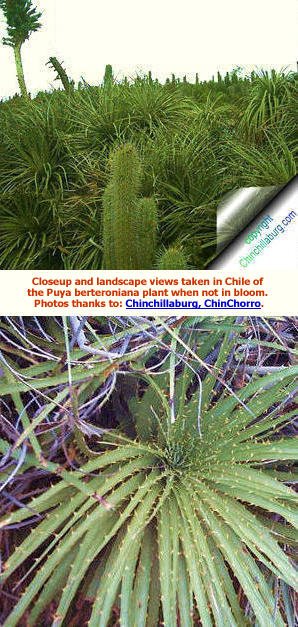
This plant description and hyperlinked photos of Puya berteroniana in bloom by strangewonderfulthings.com:
“Each spring, this relative of the pineapple sends up a massive flower stalk 6 feet tall and over a foot wide, covered with 2” blooms (photos below) of emerald-turquoise that have bright orange anthers. The turquoise color is extremely rare in the plant world, and it’s even rarer to be combined with orange. The large stature and riveting coloration of the Puya gives it a presence that is truly awe-inspiring. Puya (P. berteroniana) is a terrestrial Bromeliad from the mountains of Chile.

Puya berteroniana flower stalk 
Puya berteroniana flowers bloom
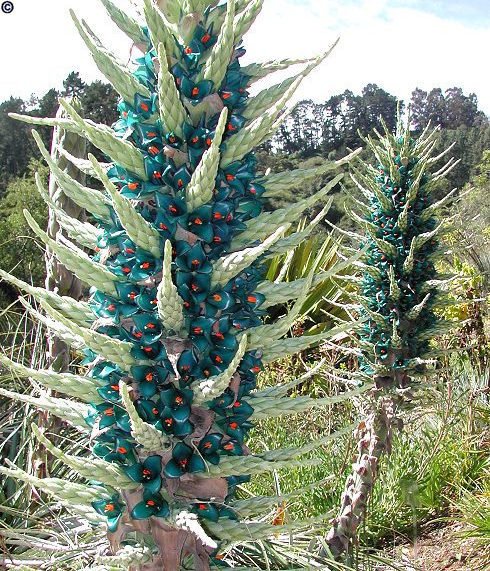
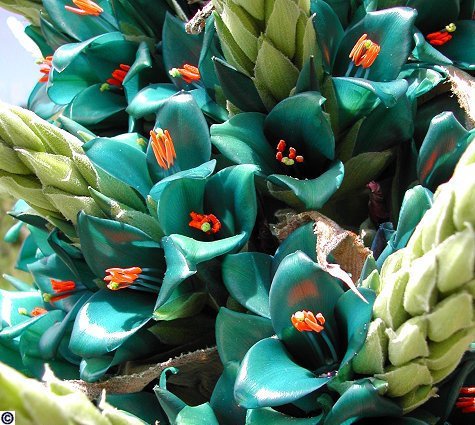
“It forms a rosette of silvery-green leaves that stand about 3 feet tall. The leaves are spiny but the flower stalks themselves are soft and the flowers are silky-smooth. Unlike the tree-dwelling Bromeliads, Puya has fully-functional roots and grows in soil. Eventually, it forms a large stand of offshoots 6-8 feet across. Puya is hardy to zone 8b-11. Mature plants can survive temperatures down to 16-20°F if kept relatively dry. P. berteroniana needs to be protected from frost the first couple of years, and it can take 5-8 years to reach flowering size.”