Introducing Chinchillas
Our advice on introductions is drawn from years of doing literally hundreds of introductions using a variety of methods with chinchillas of both sexes, from all backgrounds and social experience, as well as from networking internationally in the rescue community and from correspondence with chinparents.
Chinchillas are complex and truly unique as individuals; they vary as much as people do. Chinchilla introductions can be difficult and it is not an exact science, which is why there are so many different methods in circulation. We encourage people to first be knowledgeable, and then empathetic and intuitive with their chins, using their own instincts to guide them in their particular situation. Above all, a chinparent should be patient and resolved never to compromise their chin’s health, happiness, or safety.
Be advised that some advice regarding introductions is barbaric and should be avoided. For instance, never trim a chin’s whiskers because they do have feeling in them, they’re used as a sensory organ, to explore the environment.
It is a common myth that males cannot cohabitate as adults. Chinchillas of ANY gender, age, or background may fight if not “introduced” before cohabitation. It is critical to realize that once a physical injury has been inflicted (wounds, missing digits, etc; fur slip and urine-spraying are not injurious), the attacker and his victim will NOT be compatible any longer, period, they must be separated and remain that way. They will not just “work it out on their own,” regardless of whether they’re related or whether they’ve been bonded for years, and attempts to force compatibility in such a situation will only result in more serious injuries and even death from injuries or stress.
A chin that gets a lot of personal attention and interaction from his chinparent and seems perfectly content with that, does not “need” to have a cagemate. It is always preferable to either adopt a bonded pair or LET YOUR CHIN CHOOSE HIS OWN FRIEND rather than go through the often difficult introductory process. You can contact a rescue service or pet breeder and ask about bringing your chin there to be matched up, they probably already have experience conducting introductions and it will save you the trouble. This will provide more opportunities to find the best same-sex pairing (ALWAYS verify gender! Rescues are NFB) than if you just brought a chin home, hoping they’ll get along.
Precautionary Notes and Pointers
Also see: Suddenly Alone
Chinchillas are herd animals, they travel in groups in the wild. Chins in captivity also benefit from, and most prefer to have, the company of their own kind. Companionship can help decrease stress and increase their ability to cope, but it is also true that a chin can be sufficiently happy living alone provided he bonds well with and receives a LOT of personal attention and interaction from his chinparent. Be aware of the potential for Single Female Chin Syndrome: the male is the natural guardian and not all females do well alone, this can result in their becoming overly stressed and acting out at their chinparent. If this is the case, another female or neutered male would suffice as a cagemate.
Chinparents are generally too busy to serve as a viable substitute for the same-species companion that MOST chins need. Having a cagemate, another chin to be their friend, ensures they’re never alone, especially late at night after the chinparent has gone to bed. Some chins will bond more with their friend than their chinparent, but that is not always the case and most of the time when a chin has a good relationship with his chinparent, getting a friend will not significantly alter that bond. We encourage people to think of their chin’s needs first, whether their chin seems lonely and could benefit from having another chin for companionship, or whether he seems perfectly content being an “only chin.”
When same-sex chins (or another non-reproductive combination, like a neutered male or spayed female with an opposite-sex chin) are well-bonded and cohabitating happily, they should not be separated unless an unresolvable incompatibility issue arises. Chins do form deep, strong, loving bonds with their cagemates, and being parted from those they love to suit human whim does in fact inflict great distress that can even manifest itself in physical stress-related symptoms like weight loss, fur biting, squashy fecal droppings, whitish eye goop, etc.
Opposite sex arrangements must take the following points into consideration: that breeding WILL eventually result, that even related chins will breed, that constant breeding does drain a female’s resources and over time this will seriously jeopardize the health of both mother and offspring (especially predisposing them to calcium deficiency, a cause of malocclusion) and that even when not continually reproducing, females do reach an age (five years old) at which they should no longer reproduce. Consequently, to stay in a bonded opposite sex arrangement indefinitely, at some point in time the male will need to be neutered (spaying is unnecessary and inadvisable except as an emergency procedure).
Whether or not a chin gets along with his chinparent is not a definite indication of whether or not he’ll get along with other chins. Some chins that have had bad past experiences with other chins do tend to bond better with people and reject the company of their own kind, and likewise, some chins that have been mistreated by people in the past tend to favor their bond with other chins.
Temperament, which includes personality as well as the degree to which the chin is dominant or submissive, is the main determiner of compatibility. However, the introductory process (chinchilla introductions are a PROCESS!) as we have come to realize it also has a lot to do with the chins’ social disposition, whether their past experience with other chins has been positive, negative or inexperienced.
Social disposition may or may not be known, depending on whether the chinparent knows their chins’ background, but regardless of that, temperament is always the place to start in determining potential compatibility. Chins should be alike or complimentary in temperament, for example, two mellow chins, two loud (vocal) chins, two passive chins, two high-strung chins, or a dominant chin with a passive chin that appreciates and is not intimidated by him. Temperaments that are NOT alike or complimentary include a passive chin that resents and is intimidated by the dominant chin, a high-strung chin that is unnerved by a loud (vocal) or hyperactive chin, and if there is more than one dominant or leader personality type in the group (two or more), that will lead to conflict (for instance, two extreme Alphas cannot cohabitate for dominance reasons, but may become compatible if one is neutered).
Chins are very individualistic creatures, and while we believe that there’s a friend out there for every chin, it’s not necessarily the one they find themselves in introductions with- chins do not automatically get along with just any other member of their own species! Realize too that when chins cohabitate in their cage environment that it puts them in close quarters where they have to share everything, they can’t just wander off to another room when they’re in a grouchy mood the way some other free-roaming household pets can. Some chins are more difficult to find a friend for than others, but most of the time, if the chinparent has applied their knowledge of the chins’ temperaments, especially with a mind to their dominant/ submissive tendencies, then chances are very good that the chins will indeed be compatible.
As stated previously, it is always best to either get a pair that are already bonded or let your chin choose his own friend. Contact a rescue service or pet breeder and ask about bringing your chin there to be matched up, they probably already have experience conducting introductions and it will save you the trouble. This will also provide more opportunities to find the best same-sex pairing (verify gender, rescues are NFB) than if you just brought a chin home, hoping they’ll get along.
It is VERY important to verify gender before introducing chins, especially if one of the chins being introduced is a pet store chin as they are frequently mis-sexed, this will prevent unwanted pregnancy. Unless you are prepared to be a dedicated, responsible breeder, we advise same-sex pairings.
Chinchillas can cohabitate in ANY gender combination, including adult males, there is no combination that is more or less likely or “guaranteed” to succeed in the long term than the others, once all potential advantages and disadvantages are considered: Male/Male, Female/Female, Male/Female. A couple of important exceptions to note: two extreme Alpha males cannot cohabitate for dominance reasons but may become compatible if one is neutered; an extreme Alpha usually needs to stay single or should be neutered to cohabitate peacefully with either sex. And, there can be only one (neutered or not) male per female or group of females. If there is more than one male cohabitating with a female/s, this will result in conflicts between the males, even if the males are neutered. Male groups and female groups can coexist in the same household with precautions observed.
Pairing a recently-weaned chin with a middle-aged or senior chin often does work, because a recently-weaned chin is usually socially inexperienced, provided he wasn’t abused by his littermates or by cagemates in a pet store situation, and age usually makes chins more mellow. HOWEVER, pairing chins with a smaller age gap (weeks, months, even a year or two) will usually not approximate the same advantage.
When a male has been with a female he assumes the role of guardian and other males are viewed as adversaries. A male who has recently been with a female will need about a week alone to readjust before being introduced to another male.
It’s important to have a preestablished, positive bond of trust established between the chinparent and all participating chins prior to putting them through the inevitable stress of introductory sessions. This bond of trust is especially important if one of the chins has endured past neglect, abandonment, or abuse by people and has subsequently become hyperdefensive toward both people and other chins. New chins need at least a week, sometimes more, to settle in and bond with you before intros, and some chins may also require behavioral rehabilitation. Chins need to feel safe like they can trust their chinparent to make responsible decisions because the chinparent does effectively hold their life in his hands; a bond of trust will take some of the stress out of introductions for them as well as make them more responsive to their chinparent’s vocal coaching.
Although chinchillas can definitely get along in groups of more than two in captivity, limiting groups to two, or pairs, greatly reduce the potential for cagemate conflicts. As more personalities are added, the potential for future conflict increases exponentially: anyone added to the group will need to have a temperament that is compatible with the others, including being compatible on a dominant/ submissive level to fit into the existing social order. A cage that is large enough for one or two chinchillas will probably result in overcrowding if more are added, the Martin’s Townhouse is an example of how large a cage must be to comfortably accommodate up to four.
Chins need to be introduced individually at first, one on one, before being introduced as a group. This ensures that all members of the group truly get along with all the other members before they have to function as a group, and it discourages cliques and scapegoating once they’re all together. When introducing a newcomer to an already bonded group, separate all chins in the group for about a week (different cages, out of view) before reintroducing them individually, one on one. When former ties are relaxed it makes chins more receptive to bonding with a newcomer.
Sometimes an “only chin,” one that has been kept singly for a period of time and has staked a territorial claim on his chinparent and premises, will make intros difficult in an effort to drive off the “competition” and maintain his status as THE chin of the household. If the chin has a very dominant personality and appears quite happy and content to be alone, then as long as he receives a lot of attention and interaction from his chinparent he may be better off as a single chin.
Related Video:
Introduction Method Warning
Normally we don’t advise against introduction methods, we have used many ourselves over the years with success, and in our opinion, the only valid objection would be that a method puts the chins at undue risk for acute shock or physical injury (wounds, missing digits, etc; fur slip and urine-spraying are not injurious). We believe that Smooshing and Side by Side Cages do pose this risk. For years we’ve heard from chinparents and other rescuers whose chins were injured (sometimes killed) or began acting anti-social toward both other chins and their chinparents after using these methods. Probably the most common email that we get on this subject is from a chinparent asking if there is anything they can do to “fix” things because they used one of those methods and now their two thoroughly antagonized and hostile chins absolutely hate each other. In our opinion, after years of hearing this, we feel justified in issuing a warning to others.
Typically, the people who give the most online advice are not the same people who spend hours every day working with high-strung, oversensitive, or troubled chins, and that’s why these chins are so often overlooked, misunderstood or dismissed as the exception. Thus, when Smooshing and Side by Side Cages are recommended by some people, what they fail to realize is that sometimes a method only appears to work because of the type of chins they’re introducing, like a hand-raised pet, bred and docile ranch chins with positive or inexperienced social dispositions. When both chins being introduced are of the easy-going, well-adjusted, passive type, they often CAN get along without any introduction at all, provided their temperaments and dominant/ submissive tendencies are also compatible. Since intros are a moot point with these chins, they inadvertently make ANY introduction method appear “successful.”
But this is not representative of the common experience, what the average chinparent will encounter, because overall it is more common for a chin to be socially negative (due to a bad past encounter with other chins) than positive or inexperienced. This fact poses potential complications and risks (acute shock, physical injury) during introductions that Smooshing and Side by Side Cages will only exacerbate.
Smooshing involves cramming two chins into a tight space where they can barely move, sometimes with an artificial scent rubbed on their nose, and leaving them that way with supervision for anywhere from about five minutes to a half-hour. This method has been promoted in the U.S. pet community by one person in particular, who by no small coincidence also sells “Smooshing Cages.”
Not all chins will back down when cornered, and when a small animal of prey is cornered, this in itself inflicts extreme stress and can instigate hostility, especially so if the forced confrontation is imposed on a chin that’s already high-strung, frightened, that doesn’t have a bond of trust with their chinparent or is untrusting of other chins. A presumed tight fit holds no guarantee that a chin can’t still maneuver into a biting position, under their fur they’re not as bulky as they appear, and in such close striking range, lethal damage can occur before intervention is possible. Chins that appear mutually intimidated and show submission during smooshing can be biding time until they meet again, in a larger cage environment where there is ample opportunity to attack. Smooshing is dangerous, it often results in injury or death from wounds or acute shock; in one online poll on a major forum, approximately half of the participants voted that Smooshing had ended tragically for them.
From one pet forum quote, revised and reproduced here with permission of the author: “I have seen way too many times the very nasty negative side of smooshing, and in fact have a very badly beaten female in the rescue right now that was put through this by her owners. I didn’t think she would survive the first night, but after a month and some very gentle nursing she has made a recovery, at least physically, mentally I doubt she will ever go back to the sweet people-friendly chin she once was…”
Years ago we tried something similar to Smooshing with chins of various backgrounds, the only difference being that our version didn’t involve scent confusion, which we oppose because anything rubbed onto a chin’s nose can potentially get into it, and they breathe through their noses. In the more than a dozen times that we tried it, Smooshing always resulted in very traumatized chins, with occasional injuries to both them and us, including one time when one of the webmasters was bitten clear to the bone in an intervention attempt. The very last time we used it, Smooshing resulted in death, from a deep bite wound to the top of the chin’s head.
Side by Side Cages involves putting two cages side by side for a period of time from days to weeks or starting with the cages across the room and moving them closer to each other over time. Once side by side, the cages are not supposed to be actually touching, the intention is “to allow the chins to constantly see one another and become accustomed to one another’s scents and presence.” The theory is that when they finally meet face-to-face, it’ll be like a grand reunion of old friends…
This method may seem plausible and harmless, but then people aren’t as preoccupied with territorialism (see that section for information on scent and home territory) as a small animal of prey is. Suppose that somebody moved in next door to you and their idea of getting better acquainted with you BEFORE actually introducing themselves was to park their car in your driveway for a week or two first…
Chinchillas actually do have a territorial range or “comfort zone” that extends a few feet out from their cage in the directions they can see and by instinct, they want to defend and secure that immediate territory. A chin right next door that won’t (can’t) go away constitutes a territorial violation and this can make some chins extremely antagonized and irate, others horribly stressed.
We corresponded with one chinparent who tried this method and the resident chin, who was an “only” chin at the time, became very upset and tried to get at the chin in the cage nearby. Although he couldn’t reach him, the other chin nonetheless became listless and hunched in fear, then one morning a few days later was found dead from acute shock. His memorial below. Other times, rather than trying to get at the other chin, they’ll take up guard at the cage wall closest to the other chin’s cage. People often mistake this defensive action for their wanting to be friendly or close with the other chin when in fact, they’re feeling violated and acting on their fear and apprehension.

Side by Side Cages can predispose one or both chins to view their rival (the chin in the other cage) with loathing even before they’ve actually met, and this latent hostility is expressed when the cages have been placed too close together and fingers or toes get bitten off. Some people see the chins trying to get at each other by biting at their cage bars and just assume that they’re “eager to be friends” but when provoked chins finally meet, there will be fighting, not hugging.
From our mailbag, by a pet breeder: “I got a beautiful white vc male, finally of breeding age, out of my beautiful (and healthy and greatcoat and all that) Ritterspach white and planned to introduce him to a violet girl from a friend who has some of the single largest chins I’ve seen in my lifetime. I put them together by placing him in a small cage inside the big one that the girl occupied, this was after three months of them in cages side by side. I finally let him out of the small one inside the big one after three weeks of that arrangement, along with a dust bath so that they would hopefully commune and get along. Went to change the baby, came back, not ten minutes later she had killed him stone dead.”
Cage Within A Cage (CWAG) Method of Introducing Chinchillas
If your chins have been put through either Smooshing or Side by Side Cages and now exhibit extreme animosity towards each other, then chances are great that they will not be compatible in the future under any circumstances. If you choose to try the CWAC Method after the damage has been done with those other methods, then give the chins at least a few weeks apart, out of view of each other, to forget and recuperate. If using those methods has caused physical injury (wounds, missing digits, etc; fur slip and urine-spraying are not injurious), then the chins involved are definitely no longer compatible and further attempts to force compatibility will only result in more serious injuries and even death from injuries or stress. As stated in Precautionary Notes and Pointers, a new chin needs to have a week or more to establish a bond of trust with their chinparent before being put through the inevitable stress of introductory sessions.
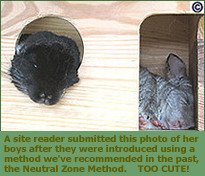
The following is just our version, which differs significantly in some key ways, of the Cage Within a Cage method, which is sometimes referred to as “Large Cage, Small Cage.” CWAC predates us, it’s been around for a long time, it’s just one of many introduction methods we’ve used and advised on with success and it seems to be a good fit for some people with low-stress tolerance and busy schedules. We only emphasize that whatever method a chinparent chooses, it should never put the chins at undue risk for acute shock or physical injury (wounds, missing digits, etc; fur slip and urine-spraying are not injurious). Our version of CWAC, as set forth below, has proven safe in our and others’ experience. It is best to read through all the points first before trying this method, to be prepared.
1. Introduction to CWAC
This version of CWAC takes place continuously, to avoid prolonging the stress and aggravation that inevitably affect both chin and chinparent to some degree with any introduction method. Remember that you are running the show and that you will have to make judgment calls and decisions within the context of your particular situation. Introductions are not an exact science and the chinparent must be mature enough to exercise empathy, intuition, and PATIENCE.
Chinchillas are socially complex and their introductions are usually a PROCESS wherein the chins are given the opportunity to get to know each other, to sort out their differences, to determine social rank (according to who is more dominant, for example, two extreme Alphas cannot cohabitate for dominance reasons, but may become compatible if one is neutered) and to achieve compatibility. If you try to force compatibility or rush the introductory process, there’s a very good chance it will backfire and ruin any hope of cohabitation. So don’t expect “instant” answers or “instant” results from first impressions, just follow the process and let the chins work things through under your guidance and supervision.
Be prepared to stay nearby and supervise constantly for up to 24-36 hours (you may want to get a friend to help), maybe a little longer if you believe they just need more time, but if they haven’t sorted out their differences and determined social rank by 48 hours then they should be regarded as not compatible and this is a possibility that the chinparent must be willing to accept. If the chins are not compatible they cannot cohabitate, and the chinparent is responsible for being prepared to provide them with separate living arrangements. If you plan to introduce one of the incompatible chins to a different chin, later on, allow him at least a week to relax and readjust before beginning another introductory session.
2. Acknowledging Gender and Establishing Trust
We refer to this as the “Butt-to-Butt”: Get a friend to help, and take a chin each and sit right next to your friend, side by side, on a couch or sofa as opposed to sitting on the floor where the chins will be preoccupied with wanting to get free to run and play. Position the chins in your laps so they’re held still and facing each other at about a foot apart, and just let them look at each other for about 20 seconds.
After that time is up, put one chin’s face under the tail of the other chin, but with a couple inches’ space between nose and tail to prevent the very real possibility of the chin lunging to nip or bite. When the chin shows some acknowledgment, give the other chin the same opportunity to detect gender, then again hold them a foot apart, face to face, for another 20 seconds. This will serve to reinforce the connection between seeing the other chin and acknowledging his gender, which can help avoid excessive dominance-related behavior, later on, males in particular sometimes get more aggressive and insistent with other males when they think they’re dealing with a coy female.
Next, position the chins back to back, butt-to-butt so that they ARE touching in a way that they can feel and know that the other chin is now behind them. Keep them like that for one minute, again, holding them gently but firmly so they don’t squirm because this will make the other chin nervous about being attacked from behind. The ability to turn their back on the other chin helps build trust.
3. Cage Preparation
The cages used for CWAC must be thoroughly cleaned in order to be used for introductions, and a show cage can be used as the small cage, the one that will go into the large cage. A show cage can usually be obtained from a pet breeder or rancher, they’re available in both the US and UK or you can use any wire cage that is able to fit into your large cage. If you can’t obtain a cage that will fit into your large cage, then an alternative to the large and small cage arrangement is to use a wire carrier in a small room.
Put the chin that is most likely to make trouble (e.g., the resident chin, not the new chin, but if both are resident chins then you must choose) inside the show cage (or carrier, if using the “wire carrier in a small room” alternative) first, with a pillowcase or piece of fleece cloth to make things comfy. Wrap a towel (no strings, fringe or loose weave, to avoid problems associated with accidental ingestion) around the top and two sides of the show cage (or carrier), tucking it underneath so that it can’t be pulled aside. This way, when a chin is inside the show cage, he cannot be confronted from every side, he can retreat if he chooses, and should the other chin get on top of the show cage, his toes won’t get bit.
Be sure the large cage (or small room) is outfitted with pellets, hay, water, and a chew toy, but NO wheel that they could compete for and NO hideaways (tube, hammock, house- no plastic) where they could barricade or shelves/ perches where they could gain leverage and power advantage over the other. It is also best to use just one level of the large cage, which can be achieved by blocking off the entrance/ exit ramps so that neither chin will camp out at the top and use the advantage of that position to refuse to allow the other access to the upper cage levels.
4. First Impressions
Put the other chin into the large cage. Allow this “free” chin to look around and talk to the chin in the show cage for about 5 minutes and then let the show cage chin out, simultaneously removing the show cage (or carrier) from the large cage (or small room) so that both chins are roaming the large cage together. Leave the cage doors open and you must have your hand right there, ready to intervene should any problem occur. You may want to wear gloves in case one chin should emerge as a biter. Other than vocal coaching and intervening when necessary, abstain from interacting with the chins during their introductory process because this can cause a number of problems- distraction, confusion, competition, jealousy, etc. If using the small room alternative, be aware that some chins will try to perch on or hide under their chinparent, using him like an edifice from which to gain leverage or barricade against the other chin, and this should not be allowed to occur.
Vocal Coaching
It is extremely important to talk the chins through their intros, vocally coaching them with positive encouragement continuously, as long as they’re behaving, and be especially affirmative and praising if they’re demonstrating compatible behaviors. Chins that have a bond of trust with their chinparent will be receptive to approving or disapproving tones, the tone of voice used is actually more important than the words spoken during coaching. For instance, when saying “no” use a deep, serious, disapproving tone, and when saying “good boy/ girl [insert name, using names gives more specific direction]” use a more high-pitched, light, enthusiastic and approving tone. Of course, never be loud or mean with your tone, at the very least it’s counterproductive.
Typical first reactions include:
Sniffing under tails to be certain of gender; walking around each other a bit warily; running on top of each other, which is just fine as long as there isn’t hostile pursuit; dominance mounting to establish dominance and social rank over the other chin is typical male behavior but it can also occur between females; with an M/F pair the male will emit a mating call and there will be soft cooing and flirtatious tail wagging on his part (the tail curls as it moves from side to side, like a cat’s tail). This is their courting ritual and some males that are still uncertain of gender may do this with another male. Females have been known to wag their tail, too, but this is chiefly a male behavior.
Compatible behaviors include:
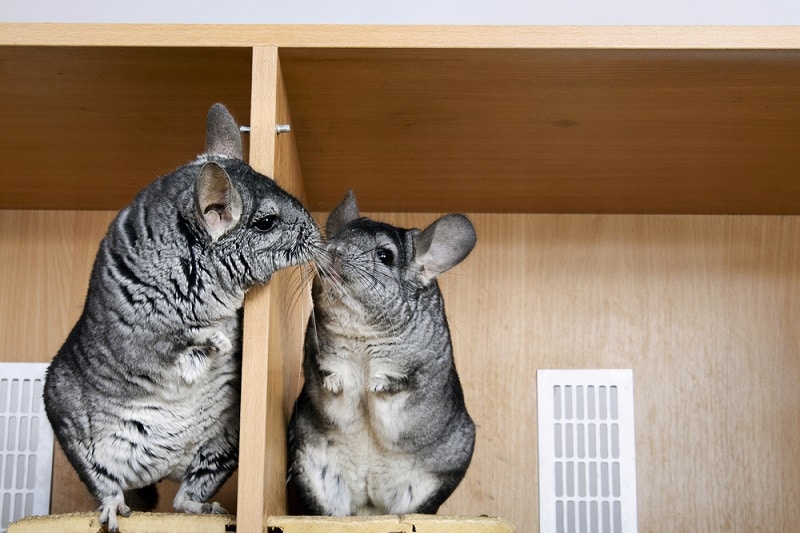
“Talking,” where they bob heads while touching noses and mouths. This is often the first sign of compatibility and when it happens without either chin getting alarmed or defensive, then this demonstration of mutual trust and interest is an excellent sign that the chins will ultimately be compatible.
“Grooming” the other chin around the face, ears, eyes, etc., is an expression of regard and affection and it can be very enthusiastic but shouldn’t become intense and rough, because sometimes grooming is used as a tactic to make the other chin submit in preparation for mounting. Friendly grooming can look like one chin “eating the other chin’s face” and that makes some chinparents a bit nervous, but grooming is markedly different from an attack, it is done carefully and courteously and critical gruffs of discomfort or displeasure are heeded by the groomer. If the groomer is not heedful of criticism and instead becomes insistent and rough, then he’s grooming with intent to subjugate and mount and this behavior should be discouraged with a time-out.
Sitting or resting right next to each other shows that they’re relaxed in each other’s presence and this behavior pretty much seals the bond and means that the chins have successfully achieved compatibility.
5) Time-Out
Although in a Male to Female introduction it is typical for the male (neutered or not) to repeatedly attempt to mount the female, and for her to react coyly (e.g., raising her butt in the air to make mounting difficult or impossible) or with outright hostility (common reaction) in response to his advances, and then for her to eventually get won over by his wooing (mating call, tail wagging) and persistent, sometimes aggressive attempts to mount… if the chinparent’s plan is to have the two successfully cohabitate after introductions, then it is necessary to discourage some of the more extreme and potentially injurious behavior that can surface during the courtship ritual.
Therefore, if a chin attacks, intimidates, or hostilely pursues (some mounting and urine-spraying are typical, give the chins a chance to work that out, but it shouldn’t be persistent or aggressive) the other chin, then the offending chin must immediately be removed from the large cage (or small room), put into the show cage (or carrier) for a time-out, and then the show cage is returned to inside the large cage with the towel wrapped around it, as before. The other chin can remain free inside the large cage (or small room) but don’t allow the free chin to antagonize his attacker, it needs to be clear that the attacker’s behavior is being reprimanded, not that you’re setting up the attacker to be taunted and tormented because you’re playing favorites.
Also be aware that sometimes a chin who has been subjugated by dominance mounting in the past will assert him/ herself with the attitude “dominate or be dominated” in the present situation, and this may manifest itself in a hostile preemptive strike that appears unprovoked.
Time-outs should be at least 30 minutes long, to make an impression that anti-social behavior incurs consequences, but it can be longer if needed, up to an hour. Usually one, then the other chin will misbehave to test your fairness and it’s in the best interests of both that time-out is used because addressing anti-social behavior from the start has long term benefits once the chins are cohabitating. Time-out curbs or “trains” the chins out of anti-social behaviors, reassuring them by demonstrating that you will not allow either to subjugate or hurt the other. Also, attaching a consequence to the disapproving tone you should use when they begin to antagonize each other will make it much more likely that they’ll heed your vocal coaching next time.
Between males, SOME dominance mounting to determine social rank is perfectly normal and to be expected. Beta males are passive and usually easy to introduce but typical Alphas make up the majority, about 75% in our experience. Typical Alphas only mount for the purpose of determining social rank with other males or to attempt to mate with females, and they can eventually be discouraged from initial excessive dominance mounting (which often instigates fights) with a time-out. The extreme Alpha, however, is persistent (mounts relentlessly, even after rank is established) and/ or aggressive in his mounting (rough grooming that pulls head fur or biting about the head, neck, and ears) and usually requires neutering to achieve (non-reproductive) compatibility with either sex; sometimes the single life suits him best.
NOTE: If physical injury (wounds, missing digits, etc; fur slip and urine-spraying are not injurious) is inflicted before you remove the attacker for time-out, the chins will no longer be compatible because this is too serious a violation of trust. Your role as a coach (vocalizing encouragement) and referee (using time-outs) must be extremely fastidious so as to always intervene in time to prevent injury. Some people expect conclusion evidence to present itself immediately in an introduction, they mistakenly believe that when the chins don’t get along right off, it’s game over.
But as stated previously, chinchilla introductions are a PROCESS and it USUALLY takes some time and several time-outs to give the chins a CHANCE to get to know each other, to sort out their differences, to determine social rank (according to who is more dominant) and to achieve compatibility. As long as there is no physical injury, there is no conclusive evidence of incompatibility, so there is still a chance of working things out. Ultimately the chinparent must decide for themselves, based on their knowledge of their chins and from watching them during introductions, whether they’ll eventually become compatible.
6. The First 24 Hours
After the time-out period is up, release the chin in the show cage, again simultaneously removing the show cage (or carrier) from the large cage (or small room) so that both chins are roaming the large cage together again. As long as neither is hostilely pursuing, intimidating or attacking the other, they can remain free but if not, then the offending chin is given time-out as previously described. Once they have been consistently exhibiting compatible behaviors (with access to all levels of the cage) for an hour or more, and you feel confident that they are ready to cohabitate, then let them stay together in the large cage under very close supervision for the next 24 hours. If using the “wire carrier in a small room” alternative, the chins would then be put into a just cleaned large cage.
If they seem able to share a wheel, return that to them, and provide other distractions like a variety of chew toys and music or TV. However, and this is very important, do not put hideaways (tube, hammock, house- no plastic) OR shelves/ perches back into their cage for the week immediately following introductions. There is often a tendency to get territorial, to try to barricade or gain leverage over the other chin once they’re cohabitating and if this occurs it will completely undo the trust that was achieved during introductions. They need that first week without hideaways and shelves/ perches to become accustomed to having the other chin close by, sharing their space and resources. After the first week, return shelves/ perches and be sure to provide a hideaway for each cohabitating chin in order to prevent conflicts, because even chins who live together and get along well sometimes want their own space.

While observing them for the first 24 hours, watch for subtle bullying behavior. For instance, if a chin stays on the bottom of the cage and acts afraid to go up, or if he’s running on the wheel nervously like he’s trying to run away or seems afraid to get off, then he may be getting bullied. If a chin positions himself at the top of the ramp so that the other can’t get by, or if he’s camped out near the wheel waiting for the other to get off, then pick him up, the one doing the subtle bullying, and put him elsewhere in the cage, or put the bullied chin on the top floor to counter the antagonizer’s power play. Watch for potential role reversal, in case the bullied chin assumes he’s immune to reprimand.
WATCHING for the first 24 hours is best, and this is why it’s good to have a friend to help. Sleeping next to the chins’ cage and listening during the night will tell you whether someone’s getting hurt, but it won’t allow you to view precipitating behaviors in order to determine what’s really going on, who is provoking whom, and whether the chin you caught “in the act” was the instigator or simply acting in self-defense. A very submissive chin will put up with a lot and then one of two things will happen: if he is able to repel the more dominant chin, he will corner him and force him to keep his distance and if that doesn’t work, he’ll attempt to kill him as a matter of personal survival -but- if the submissive chin cannot repel the more dominant chin, then he’ll be forced to submit to constant subjugation and the threat of injury at the hands of his oppressor while incurring stress-related problems (weight loss, fur biting, etc.) from being forced to live in a state of constant fear and anxiety.
Only by watching for the first 24 hours can the chinparent get an accurate assessment of the chins’ situation and continue to discourage anti-social behaviors with time-out. Chins do eventually recognize what behavior is being discouraged with time-outs, but while some may realize that the chinparent does not want them to practice that behavior at all, others will only comprehend on the most superficial level as if the chinparent has some obscure personal objection to that behavior being done in their presence and so they’ll persist in a more devious fashion to avoid offending the chinparent and incurring consequences.
7. Reinforcing Bonding
Chinchillas are extremely intelligent, and they can learn the names of their cagemates. To encourage that as well as to reinforce group bonding, try this technique: Reach into their cage to pick up one of the newly bonded chins and if he runs over to his cagemate, say, “Good boy (sub name of the cagemate)! You’re protecting (sub name of the chin that doesn’t want to be picked up), good boy!” Then back off, close the cage door, and walk away.
This might seem a bit silly, but it demonstrates to them that their show of solidarity, their bond is valued and respected by their chinparent, thus reinforcing their bond and encouraging future solidarity. This is a helpful trick to use if newly bonded chins start to act up toward each other, say if one is edging the other away from the food dish, or is trying to ambush the other chin while he’s using the wheel. Of course, use discretion and only do this a few times in the beginning of their cohabitation to help reinforce bonding.
Be aware that chinchilla relationships are complex and can change over time, usually for the better with their bond getting stronger when introductions have been successful, but it is important to always observe cagemates for continued compatibility. If a significant cagemate conflict occurs, as long as physical injury has not been inflicted, the chins can be put through another introductory session to reestablish their bond.
The Social Disposition Indicator
In the years that we’ve closely observed and conducted introductions, we’ve come to realize that the prime indicator of how a chin will react in an introductory session depends on what his past experience has been with his own kind and whether that experience has been positive, negative or whether the chin lacks social experience altogether. Experience, whether for good or bad, predisposes both people and animals to have particular expectations of future encounters. While people can choose to excuse or dismiss a bad experience, animals cannot. They are restricted by instinct, biologically “programmed” if you will, to learn from the past and to apply what they’ve learned to future situations. It’s essential for their self-preservation that they do this in order to anticipate and react to a perceived problem before they suffer the consequences, regardless of whether people are able to realize this and empathize with their point of view.
Socially Negative
Simply put, a chinchilla that has had bad experiences with other chins in the past, who has been attacked, intimidated, or hostilely pursued will be predisposed to exhibit likewise to other chins in the future. Chins tend to eventually learn how to fight back, but not all anti-social behavior is learned, sometimes it is instinctual to a high-strung or oversensitive chin. A chin that has been attacked, intimidated, or hostilely pursued in the past may or may not need provocation in the present, chins can strike preemptively. Because chins do tend to mellow with age and the passage of time, a chin who’s had bad experiences with other chins in the past may be less hostile toward other chins in introductions in the future.
When a chin adopts anti-social behavior toward other chins, this does not make him “bad” or “mean,” but in rare situations when a chin is severely socially negative, when the anti-social behavior extends FAR beyond the usual bit of dominating or scuffling to the point where there’s a definite intent to kill such a chin is best off neutered to reduce his extreme hormonal drive, or should remain a single chin. But nearly always, a socially negative chin can be trained out of anti-social behavior with an introductory method that directly addresses and curbs this behavior.
Socially Positive
Chinchillas that have had only positive social experiences with their own kind will normally have a positive social disposition toward other chins, unless a high-strung or oversensitive temperament predisposes them toward anti-social behavior. A socially positive chin will anticipate that other chins are friendly, he’ll rush in to greet and groom or casually meander about during introductions, he’ll even turn his back on the other chin out of trust, without apprehension or fear of negative consequences. Socially positive chins are outgoing, unassuming, and accepting of the other chin during introductions, after all, their past hasn’t taught them to be guarded or fearful.
Socially Inexperienced
Social inexperience is a temporary state, once a chin encounters other chins he makes judgments and forms opinions based on that experience and becomes socially positive or negative.
Chinchillas with very little (littermates) to no social experience with their own kind are socially inexperienced and the way they react in introductions reveals that: they’re generally excited about getting to meet the other chin and they express naivete, interest, and curiosity, they don’t know what to expect in return but their approach is open and willing. This is why the advice to pair a recently-weaned chin with a mellower middle-aged or senior chin often does work, because a recently-weaned chin is usually socially inexperienced, provided he wasn’t abused by his littermates or by cagemates in a pet store situation. Pairing chins with a smaller age gap (weeks, months, even a year or two) will usually not approximate the same advantage.
Ranch chinchillas are a prime example of social inexperience. On the ranch, they are housed in their own separate cage compartments after weaning, and if they are put into the ranch’s breeding program they get very little socialization by virtue of the polygamous breeding system (used by most U.S. ranchers), which bypasses the need for introductions because the male can come and go from the female’s cage at will while she cannot.
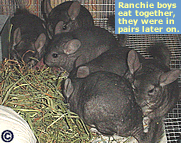
We have been saving ranch chinchillas from pelting since 2004, per Pet Homes For Ranchies, and we always spontaneously group chinchillas in carriers for the ride home to begin their adjustment period. By the time we arrive, a few hours later, the males have already begun to form social dispositions for positive or negative based on this brief period of socialization, their first impressions, and many have to be consequently re-grouped.
In the first few days, as their social experience accumulates, the males’ reaction to their fellow ranchies becomes more definite, resulting in continued defensive, hostile (socially negative) or compatible (socially positive) behaviors that we watch closely and use to guide us in yet more re-grouping until everyone is happily cohabitating. Ranchie males ultimately are most stable in groups of two while females are more willing to congregate in large groups. It should be understood that our experience may not be representative of ranches or ranch chinchillas everywhere, but we have had corroboration by others who save ranchies.
Conclusion
When a chinchilla’s adoption source is something other than a ranch, when it’s a pet breeder, pet store, rescue or rehomed source, then they’ve probably developed a social disposition, either for positive or negative. Socially positive or inexperienced chins are the easiest to introduce, provided that both chins to be introduced are of one of those social dispositions. When that’s the case, introductions may not be necessary at all, provided that the chins’ temperaments and especially their dominant/ submissive tendencies are compatible.
Overall, it is more common for a chin to be socially negative than socially positive or inexperienced, but in any case a chin’s social disposition doesn’t come to the surface until introductions are underway, and this is why it is absolutely imperative that introductions are always closely supervised and the method used does not put the chins at undue risk for acute shock or physical injury (wounds, missing digits, etc; fur slip and urine-spraying are not injurious).
Related Video: