news, site index/ pet chin resources (clubs, books, all*star and non-english sites)/ critical points

about, disclaimer, copyright make a difference: fur-free pledge/ confronting cruelty/ matildesmission.org
Health & Lifestyle Pages (site index lists page contents) Chinchilla Behavior: Relating to People and Other Animals
Chinchilla Introductions and Group Dynamics/ Chintelligence and Communication/ Dental Health/ Exercise and Play Grooming, Fur and Skin Health/ Healing: Ailments & Remedies/ Nutrition/ Origins and Wild Chinchillas Today


*The Red Print: Please Read First
*Dental Health (articles and photos, dental formula, facts and problem prevention, crossley articles)
*Malocclusion (defining; articles and photos; environmental factor- calcium deficiency, inadequate tooth wear, implementing changes to address calcium deficiency and malocclusion; symptom progression of malocclusion)
Continued on next page:
*Supplementing Vitamin C for Dental Health (articles, vitamin c sources)
*Supplementing Calcium to Correct Calcium Deficiency (calcium metabolism, moderate ca:no p calcium supplementing, articles, bladder stones in perspective, calcium sources)
Continued on next page:
*Positive Results from Vitamin C and Calcium Supplementing: Correcting Calcium Deficiency, Reversing Malocclusion (herd of maloccluders; casper in japan; henry, sugarpuff and dinky in the uk; sasha's miracle)


POSITIVE RESULTS FROM VITAMIN C AND CALCIUM SUPPLEMENTING:
CORRECTING CALCIUM DEFICIENCY, REVERSING MALOCCLUSION
(herd of maloccluders, casper in japan, henry, sugarpuff and dinky in the UK, sasha's miracle)

Also see these articles that have a direct bearing on this section: The Red Print: Please Read First,
Environmental Malocclusion: Calcium Deficiency, Calcium Metabolism and Moderate Ca:no P Calcium Supplementing

Vitamin C and calcium supplementing can improve some dental problems but they are NOT being suggested as a cure-all for every type of dental problem. Be advised that age, overall health and the type and severity of the dental problem will affect how the chin responds to any treatment. As stated in ChinCare's disclaimer, there is no suggestion, advice or recommendation on this site that is intended to serve as or substitute for the expert diagnosis and treatment of an exotics specialist vet.

The articles in this section (with the exception of Sasha's Miracle) are from some of the other people who have experienced positive results with vitamin C and calcium supplementing. Quotes and dates derive from actual email correspondence, and all articles were reviewed and approved by the persons involved for posting on ChinCare.


Herd of Maloccluders Gets New Lease on Life

On May 7, 2007 we, the ChinCare webmasters, heard from a breeder, TW in Arkansas, about a herd of 37 chinchillas that had arrived at her place "at almost midnight on a Friday night (Friday the 13th [of April] to be exact), and they came in soaking wet and very stressed." Her first look at the bedraggled chins led TW to believe that they were wet solely from the leaking caused by having their water bottles left in with them during travelling. But drooling from advanced malocclusion can also make chins wet...


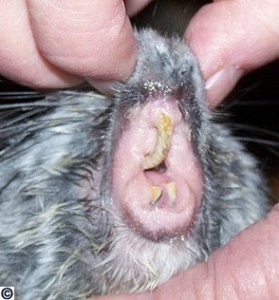
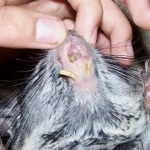
TW didn't get an opportunity to examine their health status until the next day: "Some were severely matted, which I was picking fist-sized mats out of their fur. I put one of them in a scruff hold to pick some out of her belly and she screamed... revealing teeth that curved back from the top and pierced the roof of her mouth! … I have been working for 2 1/2 weeks feeding cc [Critical Care] and crushed pellets to the worst of them, trying to keep them alive. I lost one already that was horribly matted up and the shock of the move and her teeth problems killed her... I have NEVER seen a case of malocclusion this bad... expecially not in these numbers…" (photos: 1, 2, 3)


Two of the 37 died before Matilde's Mission, a chinchilla charity that gives aid to both rescue and ranch chinchillas, got involved at our request. To help the remaining 35 chins, MM immediately sent calcium powder, Ca:no P in the form of Fluker's Repta-Calcium (with vitamin D (.doc) to aid calcium absorption), and 500mg chewable vitamin C tablets, which TW later ground into powder for easier consumption. MM also paid for the chins to be seen by DVM Leslie Block of South County Animal Hospital, an experienced exotics specialist vet.


Two vet appointments were set up to get all the chins in for examination, and the results as relayed by TW for the 5/16 and 5/18 appointments were: 6 chins had to be euthanized due to severe malocclusion, 8 had moderate malocclusion, 13 had mild malocclusion, and the rest were in the clear. TW reported that the chins were already beginning to show some improvement in their dental health as a result of better diet, which makes perfect sense because their photos, especially this one, clearly show malnutrition as the cause of their calcium deficiency (and dental disease). Incredibly, some of these chins had kits after arriving at TW's, it's just unconscionable to think that their previous owner was breeding them when they were in such poor health. All 21 treatable (moderate and mild) maloccluders were put on the Fluker's Repta-Calcium and vitamin C: "Upon returning home, I put the chins on a regimen of Fluker's Calcium powder and vitamin C tablets, crushed and mixed in with the pellets."


On July 15 we received good news from TW: "They did go to the vet [for follow-up], and Duncan (you remember how bad he was, he was moderate/severe) is VERY slight now!! Some of the others are totally CLEAR! The only one that didn't improve much is my Connor, and I'm working on him, and the brown velvet female, who WAS slight and is now moderate." And on August 20: "Yep, they [maloccluders] had final check and they are doing great but that brown velvet girl. She actually is looking quite a bit better too."


TW updated us again on November 14: "As the chins were being adopted out to pet homes, I got the slight/moderate chins rechecked again. Of those chins, ALL of them came back clear of malocclusion. I still have possession of one of the chins that was almost put down due to borderline severe malocclusion. About once a week he gets the pellets mixed with the calcium/vitamin C combination. As of his last vet visit he is still completely clear of maloclussion. It is my conclusion that the treatment of vitamin C and Fluker's Calcium powder cured the malocclusion and continues to keep it at bay. I have checked in with the adoptees who have had the chins at the vet since then, and all of the chins are still testing clear. One of the adoptees gives the calcium/vit C treatment mixed into the supplement daily, another adoptee gives it as I do, once a week mixed with the food. I have since started using this combination with my breeding females as well to help boost them after a litter."


On March 11, 2008, we got the final update on their condition almost a year after the herd of maloccluders had first arrived at TW's: "Update from all the adopters, all but one of the chins [brown velvet female] is doing great. The brown velvet female did die, the vet told the adopter that it was because of old age. He estimated her at around 25-30 years old! No wonder she was so grumpy! The one I kept is still doing great and still clear of malo [Duncan, in photo]. He's one of the top chins around here because he will lay on his back in my arms with his little feet in the air!"


Nippon Chinchilla Rescue in Japan: Casper's Story


In summer of 2007, Karen of Nippon Chinchilla Rescue approached us about our vitamin C and
calcium supplementing regimen, for possible use with one of her chins. From 3/20/08 email: "Casper's dental issues started about 3 years ago, however, it wasn't a big concern then and [his molars and incisors] only needed filing every 4-6 months to make chewing easier for him. Then in July last year [2007] while I was checking him for hair-ring, I noticed his bottom incisors were odd, they were uneven shades from ivory to light yellow and were growing outwards in a form of 'V' with a gap in between. Luckily [the head] x-ray didn't show any misalignment or root overgrowth even though his jawline felt kind of bumpy/ jagged, but nevertheless I took the warning and trips to the vet became a routine."


Sensing that Casper's case was urgent, Karen began administering vitamin C and intensive calcium supplementing (which we define as supplementing from more than one calcium source or greater quantities from a single source) about the same time we began intensive calcium supplementing with some of our chins, as described in Sasha's Miracle. For calcium sources, Karen used Rep-Cal Ultrafine Calcium With Vitamin D3 (Ca:no P, for dusting pellets) and Coral Calcium Complex Liquid: "I did notice some darkening of the incisors on the 3rd week but it was on the 7th week that my vet noticed a shift; the incisors seemed to be growing back straight with the gap being smaller. It's been 8 months since I started him on the supplementation, I'm pleased to say that his teeth now [3/20/2008] are dark yellow and even, the lower part of the incisors have closed up, growing straight and neat, leaving just a small 'V' at the top."


Since the intensive calcium supplementing had improved Casper's condition, Karen decided to scale back to just moderate calcium supplementing, from a 3/27/08 email: "When his incisors started to grow straight with the gap closing up, and dental checks were like every 6 weeks instead of 4, I thought dusting pellets [alone] would be good enough and I stopped the liquid calcium. Everything was fine until 2 weeks ago, we discovered that his bottom left incisor was like starting to over-lap the right and was shaky. Yamada [DVM Tizuko Yamada] thought it was bad and asked that I keep an eye on it and come back 2 weeks later, which is today. I started him back on the liquid calcium with Vit C that night, so far he seems fine, and he even put on weight, funny eh?"


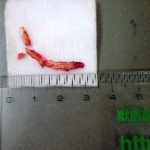
Sadly, on 3/29/08, on Casper's follow-up appointment, he had to have his left mandibular (lower) incisor extracted (photo of tooth and photo of mouth one month later). "When Yamada gave it a gentle shake, it was very loose and then it started to bleed profusely and smelt. She suspected an infection in the gums and that it was imperative to remove the incisor now before it gets really bad with complications, it would be a relief for him and we could eliminate the possibility of a root elongation from happening which would otherwise be more painful and threatening. But, there will be some swelling of the gums and bottom lips after and most likely an infection caused by food, foreign objects stuck in the deep open wound, not forgetting the stress and loss of appetite. It was a dilemma but what other choice do I have? I can see it hurts and probably has been for a while. It wasn't like that when I checked 2 days ago and he was still playfully climbing all over my back… Anyhow, he wasn't under full anesthetic, just the gums and it was fairly quick. 6 days of Baytril [antibiotic] and Metacam [painkiller] (thank God I've still some Bene-Bac [for gut upset] left), and x-ray on the 7th day."


It is important to realize that vitamin C and calcium supplementing can go a long way with helping various dental conditions like environmental malocclusion caused by calcium deficiency and loose or crooked (misaligned) teeth, but sometimes there are extenuating circumstances, like additional complications or perhaps the problem is already too advanced for a complete recovery to take place.


Casper also received a significant amount of grains during this period of his calcium supplementing, which is something we now caution against, and informed Karen of. The high phosphorus content of grains can raise phosphorus levels and impede calcium absorption, diminishing the effectiveness of calcium supplementing (ref). This would explain why Casper's improvements were sustained during intensive calcium supplementing, but not with moderate supplementing. At least Casper made some positive advances, and is in the care of a good rescuer and chinparent who doesn't hesitate to provide excellent veterinary care.


Henry, Sugarpuff and Dinky in the UK

After correspondence with Linda of Chinchillas2Home concerning our positive experiences with Ca:no P (calcium: no phosphorus) supplementing, she decided to give it a go with some chins from her rescue crew:


Henry, 11/11/07
"Henry, this little chin I have, his bottom teeth are white and there is a gap in the middle of them, his top teeth have overgrown since I brought him home (not sure why! as he only had a block of wood for 6 months with the breeder to sit and chew on and I've loads of chewies in the cage now!). It may be that by coincidence, he just 'started' to show a teeth problem when I brought him home at 6 months old, he eats well but now has this front 'eating problem' with his teeth growing a bit long to bite anything- so he's off to the vets. I'm giving it two weeks first to see if he can gnaw them back (like one of my others did once a while ago when her teeth grew too long through illness) but if not, then that's the time I'll see the vet and see about calcium views!"


11/23/07
"When he first came home with me about 6 weeks ago, top teeth were very pale yellow, bottom were white and parted like the red sea, quite a gap in the middle that I was tempted to teach him how to whistle ;-) So straight away I started on the Ca:P 2:1 – he had this on his pellets everyday, then on the 3rd of November you emailed about ‘straight calcium’ [Ca:no P, which Linda used in the form of T-Rex 2:0] so I switched to straight calcium and he’s been on that for over 2 weeks. His top teeth were not overgrown when he came to live with me, but for no reason they started to grow and grow and grow! All the chew toys in the world wouldn’t stop them as he wasn’t interested but did like his hay, so, after 6 weeks I decided he needed to go to my vet."

"I did notice that the ‘new’ tooth growth started showing a more yellow colour– his top teeth went from new yellow to white at the ends (not orange yet but getting there hopefully!) She checked his teeth at the back, there was no indication of any problems at all, the front/back molars had slight spurs on but the vet said this was more likely because his front teeth had overgrown. There was no reason why his teeth should of overgrown, and all his teeth were fine– a little pale but fine, which was a relief as I know this short bodied gene [type of chin, not dwarf] can have problems." We explained, as the Moderate Ca:no P Calcium Supplementing article relates, that tooth overgrowth at first is normal and that it stops when teeth begin to darken, indicating improved calcium levels in the body.


2/18/08
"Well, Henry over-grew the teeth once again at the front, so another file down by the vet but this time he seems to be keeping them well and truly down ;-())) It's been 4 weeks since his last file down, and the vet says his teeth are fine at the back- not sure why he lets the front ones grow, but he is chewing a bit more (and the teeth look really nice and straight now). If you remember, he had a gap in the middle top and bottom front teeth, and they had a 'mind of their own' growing outwards at the top- well to look at them at the front they look really perfect and yellow now. I wish I had taken a before and after pic- but just over a few months there is a world of difference with his teeth- they are nice, neat and happy. I will keep with the calcium for another month gradually stopping and then see how he goes ;-)"


3/6/08
"Pity I didn't take photos- as Henry's teeth are no way like they were before- they are absolutely perfect now."


Sugarpuff, 2/18/08
"Sugarpuff has a gap at the back where a tooth should be, and the tooth that should be there is 'side by side' with the end tooth at the back- very odd! Nothing could be done with that oddness, but did cause a problem with eating obviously, therefore, causing teeth to grow all over the place! She used to have to go to the vet's every 5 months- went on the 6th month this time, and the vet said she doesn't need anything doing! Teeth at back are fine- so i'll leave it for 9 months and see how she goes for that length of time. Her front teeth look really yellow and nice and very straight at the front- which is unusual for her as she always had one shorter than the other on the 5th month! (she was on Ca:P and then calcium [Ca:no P, T-Rex 2:0, like Henry] a couple or so months ago)."


Note by ChinCare: One benefit of using the T-Rex 2:0 for Ca:no P supplementing is that it contains ascorbic acid, or vitamin C, which strengthens the connective tissue around chins' open-rooted teeth. Together with the calcium that strengthens the teeth and stops overgrowth, the vitamin C undoubtably helps the teeth straighten by securing them more firmly in place.


Dinky, 2/18/08
"Dinky- she's fine- never had to go to the vet's to file her teeth, but she was the one with very overgrown front teeth aged 3 months and broke them down herself a month or two later. So [she] tends to cope with the front well herself, but they are not strong, they are white/yellow shades, and the bottom teeth cross over a little and one of them is thicker than the other. She is doing well, teeth need more work on the shape and growth of them, but she is very healthy and eats well- so will keep on with her as she will need this [Ca:no P, T-Rex 2:0, like Henry] for a long time yet!"


3/14/08
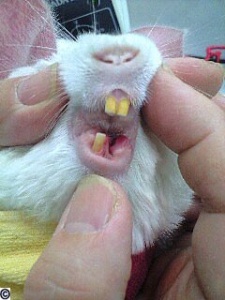
"She keeps them down- they tend to look broken down as they are never straight. They are never straight but they were all white at first- now they range from white to a good orange yellow on the teeth (at the moment she has one broken out at the bottom- probably a fall as she never usually loses a tooth!). I've enclosed a pic of how her teeth are at the moment- bottom left is missing, other overgrown a bit, top teeth ground down but there is an upside down 'V' in middle if you look- they grow all shapes and sizes! But at least they are now yellow at the top and getting a little yellow at the bottom ones (well one at the moment- the bottom ones are the ones that cross over a bit when grown)."


Sasha's Miracle and More
(follow-ups: sept 2005, july 2007, sept 2007, nov 2007, feb 2008, march 2008, april 2008, may 2008)


We, the ChinCare webmasters, knew that Sasha might not live into old age after viewing the head x-rays we had taken of her some months after we took her home from a pet store (x-ray photo, two year's difference (2001 & 2003) between the left and the right). Our first sign that something wasn't right was when we observed her whitish tooth enamel, indicating a serious calcium deficiency. Her incisors tended to overgrow, resulting in trips to our exotics specialist vet to get her teeth trimmed. The photo in the left x-ray shows the advancing malocclusion: misaligned roots overgrown and extending towards the sinus and ocular cavities. The root overgrowth in that photo is illustrative of mid (almost advanced) stage malocclusion.


Two years later, in 2003, after having access to a variety of chew toys and a good diet that included several high quality hays and pellets dusted with supplementary powdered vitamin C and
calcium, not to mention prayers for our darling girl, we saw a miracle! See right x-ray. Not only had Sasha's roots RECEDED from their growth toward the sinus and ocular cavities, but they had even STRAIGHTENED out as well! Our vet even measured the difference on the head x-rays for herself, we were both astounded at this malocclusion reversal. On that visit Sasha had a couple molar spurs clipped to make it easier for her to consume more hay, which will keep her molars filed down. This was the first time we realized the connection between vitamin C and calcium supplementing and how they can positively affect malocclusion.


Follow-Up, September, 2005: We're happy to report that Sasha's condition has continued to improve, in fact, we haven't had to trim her incisors AT ALL for several months now. Her teeth have gained some dark yellow enamel, which indicates that her calcium levels are improving, progressing in the right direction, toward dark orange. Sasha's lingering calcium deficiency is clearly the result of an inherited calcium deficiency, as evidenced by the fact that her teeth hadn't darkened during or even well after the weaning period. When a mother chinchilla has low calcium levels, the offspring are consequently short of calcium from the start, and both mother and kits become at risk for calcium deficiency and malocclusion in the future. This is why we advise both vitamin C and
calcium supplementing for pregnant/ nursing chins, their bodies are being depleted by the process of creating and nourishing new life.


Follow-Up, July, 2007: Between late 2005 and early 2006 we switched from supplementing the Ca:no P (calcium: no phosphorus) that we'd used since 2001 to a powder (T-Rex 2:1) containing 2 parts calcium to 1 part phosphorus. The problem with this, which involves how excess phosphorus causes calcium deficiency, is discussed in Calcium Metabolism; its tragic impact on our chins, especially our resident maloccluders, is elaborated on in Moderate Ca:no P Calcium Supplementing and the March, 2008 entry of this section. Sasha is one of the maloccluders who suffered greatly from calcium loss at this time.


In July of 2007, Sasha's tooth enamel was finally becoming dark orange when she experienced some weight loss, had dampness around the chin and was pawing at her mouth, so we made a vet appointment for July 31 to get a head x-ray. The x-ray revealed a case of Osteomyelitis, a bone infection caused by significant molar root elongation in the lower jaw; this condition is making it very painful for her to eat. The roots in her upper jaw have also begun to grow crooked and advance again toward the sinus and ocular cavities.


At this appointment we also had head x-rays taken of two of our other maloccluders who had, like Sasha, been in remission prior to using T-Rex 2:1. Altogether these three x-rays demonstrate the awful consequences incurred by our maloccluders (other maloccluders that went through the T-Rex 2:1 tragedy had to be euthanized or died of natural causes, the three still struggling as of this July appointment are discussed in the March, 2008 entry) as a result of using T-Rex 2:1 and the subsequent slow recovery period; their malocclusion is back, they have regressed.


As a result of the July 31 appointment, our vet has prescribed Septra (medication) and Novadent (mouth wash) to treat the Osteomyelitis, and we have begun intensive calcium supplementing, which we define as supplementing from more than one source or greater quantities from a single source. For Sasha, that will mean administering calcium from these two sources: Coral Calcium Complex Liquid plus her usual pellets dusted with Ca:no P in the form of Fluker's Repta-Calcium (with vitamin D (.doc) to aid calcium absorption). We also continue to dust our pellets with vitamin C, currently in the form of rose hips powder, because vitamin C has dental benefits for chins in any condition. We're hoping that intensive calcium supplementing will bring about another malocclusion reversal such as she experienced before.


Sasha's intake of herb and grains mix and unsweetened Wheat 'N Bran mini Shredded Wheat biscuits has been increased somewhat because she sometimes finds it difficult to chew her pellets, and the herb and grains mix is stirred into her bowl of pellets (which she shares with her neutered mate, mentioned in the March, 2008 entry), coating it with Ca:no P. The additional grains will increase her phosphorus levels some, but not much because she's no longer able to eat hay to acquire phosphorus from that, and anyway, with intensive calcium supplementing a small increase in phosphorus should be just fine.


Follow-Up, September, 2007: The head x-rays from the September 25 follow-up appointment show little improvement with the Osteomyelitis condition, and even though her teeth have become much thicker and stronger with the intensive calcium supplementing (twice as thick as before, actually), there has been no change in the root overgrowth. Our vet has prescribed a stronger medication, Vibramycin, to fight the Osteomyelitis and we've switched from the previous liquid calcium to vet-prescribed liquid calcium gluconate (one full syringe of this liquid calcium, Ca:no P, twice daily while continuing with the pellets and herb/ grains dusted with Fluker's calcium and rose hips powder for vitamin C). We've also
begun administering the painkiller Metacam.


Follow-Up, November, 2007: There was a period of about ten days at the beginning of November when Sasha was no longer able to eat on her own and she required daily handfeeding to keep her weight and strength up. Often she'd let us know that she wanted to be fed, her appetite was very good and she'd eat all she wanted about three times a day on average. Then one day she suddenly refused the handfeeding formula and was seen eating her pellets again! What a trooper!


The head x-rays for her November 30 vet appointment show that the Osteomyelitis has entirely cleared up, but root overgrowth is pretty much the same. We believe that the painkiller had a major impact on Sasha's ability to eat and recover enough strength to overcome the Osteomyelitis. Now that the Osteomyelitis is gone and the painkiller is allowing her to eat pain-free, the fur is growing back over her paws because she's no longer drooling and wiping her mouth. While she was, though, we kept her wiped with a warm, damp cloth and then dried well with a towel or blow drier; it's VERY important to keep maloccluders clean, it keeps their spirits up, and Sasha's stayed happy and active despite her troubles. Also, because Sasha's experienced significant weight loss and it's the cold weather season where we live, we've been keeping a small heater near her cage. These things (keeping maloccluders clean and warm) are stressed on Implementing Changes.


We're continuing with the September 25 regimen, but we've halved the dosage of Vibramycin and liquid calcium gluconate. The Metacam dosage, a very tiny drop twice daily, has had to remain the same because otherwise she experiences too much pain from the molar root elongation in her lower jaw to make normal eating possible. Our continued hope is that by persisting with the intensive calcium supplementing (one full syringe of liquid calcium gluconate once daily while continuing with the pellets and herb/ grains, which now also includes some Kashi 7 Whole Grain Puffs, all dusted with Fluker's calcium and rose hips powder for vitamin C), that Sasha's roots will eventually recede so that she can live a normal life again, without medication and painkillers.


Follow-Up, February, 2008: By mid-December we had to put Sasha back on her full dosage of Vibramycin, but in January she was seen eating hay and on January 29 she unlocked her cage with her teeth (like this photo) TWICE in one night, hurray! She was able to go off the Vibramycin after the first week of February and on her February 16 vet appointment, we witnessed yet another miracle! Sasha's head x-rays this time show that her roots are receding and straightening, not nearly as dramatically as with the first miracle that occurred over the course of two years, but she's nonetheless making some progress, our vet was as happy and amazed as we were, this is her second malocclusion reversal now. She still has a ways to go, especially with the molar root elongation in the lower jaw, but she's moving in the right direction and has continued eating her hay. We're continuing with the Metacam twice daily and the intensive calcium supplementing as described in the previous entry.


March, 2008, A synopsis of the others receiving intensive calcium supplementing: Sasha is one chin in a total of three groups of two (6 chins altogether) that have received intensive calcium supplementing since the July 31 vet appointment; the others have received the same type and dose of calcium that she has as described in the previous entries. As the July follow-up and the Moderate Ca:no P Calcium Supplementing article explain, we arrived at the conviction that intensive calcium supplementing was needed to address the lingering calcium deficiency experienced by our maloccluders as a result of the time we used T-Rex 2:1.


Sasha's (neutered) mate Guinness had a lingering calcium deficiency that has been corrected by the intensive Ca:no P supplementing, his tooth enamel is now dark orange.


A pair of boys, Calvin and Hobbes, arrived at our rescue in spring of 2007 and they were suffering from low bone density caused by calcium deficiency and malnutrition. They had a strange, unhealthy smell about them, were critically underweight, had a constant feeble head nod, became exhausted with very little exertion, their teeth were clear/ white and handling them presented difficulties because their bones were rubbery and insubstantial. They have made major headway since last July as a result of the intensive calcium supplementing: the queer smell is gone, their weight is now in the normal range, their heads don't nod much at all, they keep active for their entire out-of-cage exercise time (often for hours), their teeth have gained some light yellow enamel and their bodies are much more solid and easy to hold because their bones are stronger. Unlike the other two groups with malocclusion and hence chewing issues, these boys are able to eat their pellets and hay and since this fulfills their phosphorus requirement (ref), they have not received additional grains in their diet.


In the third group, Tamba, a neutered male, had a calcium deficiency when we adopted him as a kit from a pet store in 2000; his was an inherited calcium deficiency, same as Sasha. Tamba was beginning to show some real improvement, had finally gained yellow tooth enamel, as a result of the years (since 2001) that we conducted vitamin C and moderate Ca:no P supplementing. After our experience with T-Rex 2:1, Tamba's teeth became white and brittle-looking, although at no time has he yet manifested any malocclusion symptoms, no incisor or molar crown overgrowth, and he's always gnawed his chew toys and consumed hay. His head x-rays from July 31, however, showed molar root elongation in the lower jaw, not as severe as Sasha's condition that was assessed on the same day, but it was clear that he too should receive intensive calcium supplementing.


Since the July appointment, the intensive calcium supplementing has made a HUGE difference in Tamba's tooth condition, the white, brittle teeth are now thick, strong and have light yellow enamel. His February 16 follow-up x-rays show the condition in the lower jaw has remained the same while one tooth root in a back molar of the upper jaw has begun to misalign, to malocclude. We'll continue with the intensive calcium supplementing, as with Sasha our focus with Tamba is to hopefully see a malocclusion reversal.


Tamba's mate, Polgara, came to us at age seven in 2001 with one of her lower incisors a bit twisted. Not misaligned, just twisting in place from the root. The tooth continued to twist very slowly over the years, but there were no other problems at all while she was on the moderate Ca:no P supplementing; she gnawed her chew toys, ate hay and her teeth remained a good color, not even getting much lighter during the time we used T-Rex 2:1. After T-Rex 2:1 though, her incisors began overgrowing in response to the calcium deficiency, and her upper incisors began hooking sharply back. The hooking may be attributable to genetic malocclusion, we believe that when teeth twist or hook that this may indicate a genetic propensity rather than an environmental shortcoming (calcium deficiency). In any case, if Polgara's malocclusion is primarily genetic, the calcium deficiency caused by T-Rex-2:1 definitely made things worse.


The intensive calcium supplementing has darkened Polgara's teeth to a nice dark orange and the upper incisors aren't hooking back nearly as much as before, but we still do some incisor trimming occassionally to keep overgrowth in check because she's not gnawing. At 14 years old we're guarded about her prognosis because her overall condition has declined (weight loss, some drooling on and off, not as willing to try eating pellets and hay again) despite getting the same medication and painkiller as Sasha. Her head x-rays from July 31 show significant root overgrowth in both the upper and lower jaw which has stayed the same as of the February 16 x-rays.


Follow-Up, April, 2008: A couple weeks after the February 16 appointment we had to put Sasha back on the Vibramycin, first at a reduced dosage, then back to full dosage, where she's at now, and she's still receiving Metacam twice daily. Sasha has been able to eat some pellets and hay, but not so with Polgara and for awhile, since both wanted to feed themselves and wouldn't comply with handfeeding, in order to give them something they could eat on their own we offered some grains cereal in addition to their herb and grains mix.


This turned out to be a very bad idea, even though the grains cereal was porous and it got coated in the way we only dust their herb and grains mix, with rose hips powder for vitamin C and Ca:no P in the form of Fluker's Repta-Calcium (with vitamin D (.doc) to aid calcium absorption). Sasha, Polgara and their mates were also still getting a full syringe of liquid calcium gluconate once daily. Nonetheless, their mate's teeth began to lighten, demonstrating calcium deficiency because the supplemented calcium wasn't sufficient to compensate for the excess phosphorus in the additional grains (ref). So, in the first week of April we discontinued the grains cereal and increased calcium back to a full syringe of liquid calcium gluconate twice daily. This balancing act that we've been juggling to try and get our maloccluder's situation under control and headed solidly in the right direction underscores the importance of giving chins a simple diet, so that deficiencies and malocclusion might be avoided in the first place.


On the 16th and 18th, thanks to the gracious kindness of a wonderful friend in England, we received some packages containing Nutrobal and Science Selective Chinchilla, products only available in the UK. Science Selective is a chinchilla feed that's of a different size, shape and consistency than regular pellets, it will be a bit easier for our maloccluders to chew and it's also very porous and easy to coat well with Fluker's calcium and rose hips powder. Nutrobal, a calcium powder and multivitamin/mineral supplement, which isn't for dusting, will be added to the pellets in smaller amounts. We plan to serve these coated pellets to the three groups that have been getting intensive calcium supplementing and we'll see how well they do on that, it'll be the only calcium supplementing they get, which is a bit more than moderate supplementing, since Science Selective is quite porous.


It was a beautiful spring day, April 18, when our dear Polgara was euthanized. She would have been 15 in August. Her condition began to deteriorate in spite of the medication and painkiller, so we made the sad decision to put her to sleep, with our vet's concurrence. Perhaps it was too much to hope for a miracle at her advanced age, even with intensive calcium supplementing; there is also the very real consideration that her malocclusion was primarily genetic and therefore not entirely responsive to the supplementing. Polgara was a wonderful gal, she will be deeply missed.


Follow-Up, May, 2008: I, the webmistress, could not believe my eyes today when, just after midnight on May 18, I heard, then watched Sasha GNAW WOOD!! This in spite of the molar root elongation in her lower jaw which was still considerable after her last head x-ray in February. She's still on Vibramycin and Metacam and the diet as discussed in the previous entry, but because she remains underweight (of course, she's always been a small lanigera type) we've also been offering some Calf Manna vitamin and mineral pellets and Nutri-Cal, a high calorie dietary supplement, both given in moderation of course.


But this is just incredible, that she is now showing interest in gnawing for the first time in about a year, our hopes all along have been that she'd experience another complete malocclusion reversal that would make medication and painkillers totally unnecessary, so that she could again lead a normal life. Gnawing puts a good deal of pressure on both the jaw and tooth roots, so this should signify that she's still improving, and indeed her teeth have been gaining darker enamel. Our primary concern has been her lack of weight gain, but maybe we're expecting too much too soon, in any case we're remaining a bit reserved and will save the real rejoicing if we get positive results from her next vet appointment and head x-ray.