
Chinchilla Communication
General Characteristics of Communication
It’s important to bear in mind that chinchillas are truly as unique as individuals. They vary as much as people do and they deserve to be considered and related to on an individual basis, “general” characteristics are just that.
People who have a good, close relationship with their chin never cease to be amazed at how perceptive and intelligent they are. Ours understand several phrases, we’ve had chins respond on the first try to something we said just because they’re observant of our habits and motivation and because chins are intelligent enough to use what they know to anticipate what we’re trying to communicate. Chins are very empathetic and intuitive creatures, this results in a keen ability to relay what they mean or want from their chinparents, which is successful provided the chinparents are also observant and practice some empathy and intuition on their part.
Avoid breathing or blowing directly into your chin’s face. According to our exotics specialist vet, chinchillas CAN catch a virus from people, such as cold or flu. Cold sores can also be a danger if they’re scratched before handling the chin or the chin comes into direct contact with them. Also, from handling ranchies we’ve learned that by instinct a chinchilla reacts to human breath as if they’re being bombarded by another animal’s natural defenses. That is, they think that we use our breath in the same way another chin sprays urine, the way a porcupine uses its quills or a squid shoots ink; human breath can be overwhelming, repulsive, and even threatening, especially if they’re not accustomed to interaction with people.
If they want something replenished or adjusted INSIDE their cage, or if they want a treat, are eager to greet you and want some attention or would like to get out for a run, they’ll get your attention by standing up on their hind legs with their forepaws against the cage mesh as if they’re searching for something or “begging.” When they want something changed OUTSIDE of their cage environment (TV volume or channel changed, room temperature adjusted, if a dishwasher or something is too loud…), they’ll bark.
From the section on seizures, about shaking and what it conveys:
There is a head shake or tremble, which sometimes involves the body as well, that can happen when a chin is being held and he’s been startled or is feeling fear, apprehension, or dread. It’s not the same as a seizure or convulsion although it can appear that way, it’s actually a voluntary reaction (that may appear involuntary) that is situation-specific, such as from being picked up suddenly. “The shakes” can happen whether or not a chin is familiar with you and it’s been noted by us and others that the black velvet mutation seems particularly prone to this. When a chin shakes, it’s important to soothe him by speaking softly and reassuringly, hold him close and gently cuddle him; to release him before he’s been calmed would reinforce his fear. When you get a new chinchilla, he needs affirmation of your goodwill from the start.
Chins do smile and wink, and as often as we’ve seen it done, it’s not inadvertent or blinking, it’s really part of the way they communicate to people. It can be done to show contentment, to acknowledge our communication efforts, or to say, “please be gentle and love me, I’m little and scared.”
Chins do communicate by anti-social behavior, but that’s not part of their regular communication in a positive, everyday way. Pressure bites (in an urgency context) and nibbles are not actually anti-social behavior, they’re a perfectly normal, necessary part of chinchilla communication, select the hyperlink to read more.
If a chin is getting into something (while outside of his cage) that he shouldn’t, snap your fingers or clap your hands once or twice and say “no” in a firm, not loud or frightening, manner. Use this tactic sparingly or its effect will diminish.
When afraid, they may release an odor from their anal gland, which is “a scent gland located in the opening of the anus”. The odor isn’t particularly pungent but it is definitely noticeable within a range of about 2-3′, and has been described as the smell of “burnt almonds.”
Expressions of sheer joy and exuberance include: bouncing off walls, sometimes referred to as “wall surfing” and the mid-air jump and twitch, sometimes referred to as “popcorning” but better termed as, “happy dance.”
Chins will often try to catch their chinparent’s attention by climbing up to their chinparent’s eye-level (“they’re up high, I’ll have to get up high”), sometimes scaling their cage wall to do so. Likewise, if you drop a treat in through the cage bars while trying to hand it to your chin, stoop to where you’re at eye-level with the treat on the cage floor, perhaps gesture toward it as well, and the chin will find it more quickly when he can better deduce where, specifically, you’re looking.
Hear Chinchilla Sounds
Also see this site with .wav files: Cheeky Chinchillas
Chinchillas are capable of making an incredibly wide range of sounds that are mostly unique to the species but are somewhat reminiscent of a squirrel. Even though we’ve met hundreds of chins over the years, we still hear sounds that make us stop and take notice. Depending on their personal disposition, some chins are very vocal (gruffing, barking) while others may normally make no noise at all, but most fall somewhere in between.
The “meaning” or “interpretation” of chinchilla communication sounds varies by situational context and the sound itself will vary somewhat between chins. Despite how simple online sound bites may make it seem to understand chinchilla “speech,” it actually takes a while, and much listening and observing, to become accustomed to what a particular chin is communicating when he uses a particular sound in a particular situation.
Kits make a supplicating sound to entreat adults to go easy on them, this usually succeeds.
When a chin is grooming another and his technique becomes too clumsy or annoying, then the chin being groomed will make a chirp that indicates by tone, intensity and duration whether he’s a little or very perturbed and in the latter case the sound made will often be emphatic enough to conclude the grooming session altogether. In this sound clip(.wav), Zoe makes a little “leave me alone” gruff for her chinparents.
One of the most common sounds that chins make is their “bark,” which actually sounds more like honking than barking and the chin makes it by standing still and abruptly drawing in air through his nose; sometimes you can see his sides compress or his lips purse. The sound will vary in pitch between chinchillas, this soprano example was made by a female named Munchkin: sound clip(.wav).
The bark is probably best referred to as a “distress call,” and when a chin isn’t using it during out-of-cage exercise time then it indicates a reaction to something in the environment outside the cage (needs inside the cage are signaled by standing on their hind legs with forepaws leaned against the cage walls, in a begging posture). What’s being regarded as “distressing,” however, can vary greatly: when used during playtime it can be a heads-up signal to the other chins, when used by ranchies just off the ranch it can be from fear of the new and unfamiliar in their environment, when used by pet chins in their cage it can be to alert their chinparent regarding temperature, TV channel or volume change, annoyance with certain noises like that of appliances working, etc.
When a chin is familiar with you but still new enough not to be totally confident yet, he may make a kind of high-pitched whimpering sound if he thinks he’s in trouble for some perceived misdeed. It sounds just like the supplicant noise they make to their parents as kits. Incidentally, bear in mind that while kits make the supplicant noise in deference to adults, it’s not a guarantee that the adult, especially if not the parent, will necessarily be considerate of them.
Other sounds can be context-specific also, but this is a good general description by Chinchilla Homepage:
“Prone to excited sounds, Chinchillas will also emit chirps and calls according to their mood. Over time an owner will hear a multitude of these orations – all indicating the animal’s personal state. A soft cooing might indicate playfulness and comfort. A very quiet chirping can be heard while the chinchilla is exploring a new place. Some sounds will originate from the grinding of teeth, which they will sometimes do after eating.
“They do sneeze audibly, sometimes from the fine dust in their bath. If a chinchilla feels threatened, a high and loud bark will be heard, much like a squirrel can bark. The last resort will involve the chinchilla standing on hind legs and emitting both a bark and a stream of urine. Sometimes, chinchillas will emit a series of loud, hoarse barks that serve to warn other chinchillas of potential danger. They nearly always use this vocalization if they feel nervous, rather than in response to a specific threat.”
Related Video:
Speech Recognition
Chinchillas can learn their own and their cagemate’s names *IF* you speak the names regularly while interacting with them because without repetition and context reference, they won’t make the association. When choosing a name, one or two-syllable names seem to be easier for a chin to grasp than long names or a name composed of multiple words. Sometimes a chin may know his name but will show no interest in responding to it, at our rescue when we get a chin that doesn’t respond to his name we may try other names with him to see if he seems more responsive to something else, and surprisingly, sometimes it does work to let them choose their own name.
Chins have been known to learn and use squirrel chatter and parrots from across the room can mimic “chin talk.”
Chins are able to learn short phrases or keywords, such as “no,” “good,” “treat,” “playtime,” “gentle,” etc. The tone of voice and specific sounds, when used repetitively and indirect contextual reference, are key to helping the chin make the association between the word/ phrase and its meaning. For instance, when saying “no” use a deep, serious, negative tone, and when saying “good boy/girl [or insert name]” uses a more high-pitched, light, enthusiastic and positive tone. The tone of voice is often more influential with chins than the words themselves, but in any case, be advised that verbal commands should be used appropriately and not excessively.
One example of verbal command/communication is when we use the phrase “pet your paw” to let our chins know that we won’t pick them up even though we’re reaching into their cage or reaching near them during out-of-cage exercise time. To help the chins make the initial association we would say “pet your paw” while literally petting their paw. The key to a continued association between the phrase and not being picked up is that we would never pick them up after using it, that all we may do is simply pet their paw.
After using the phrase a few times in context with petting their paw (depending on the chin, some picked it up on first use while others had to be convinced that it would not result in their being picked up) we would proceed to use only the phrase “pet your paw” while entering their cage or during out-of-cage exercise time and they remained at ease. Every now and then we reinforce the connection by saying the phrase and literally petting their paw. We use “getcha” when we are going to pick them up because it has a very separate and distinct sound.
Studies in Chinchilla Speech Perception
The following appear to be landmark studies in speech perception, they are quoted and referenced often on internet research and educational publications:
- “A comparison of chinchilla auditory evoked response and behavioral response thresholds“
(Henderson, D., Onishi, S., Eldredge, D.H., and Davis, H. 1969) - “Speech perception by the chinchilla: Discrimination of /I/ and /[upside-down V]/ in various consonantal contexts”
(Nan Lynn Dunlop) - “Speech perception by the chinchilla: Discrimination of sustained /a/ and /i/”
(Burdick, C. K., & Miller, J. D. 1975) - “Speech perception by the chinchilla: Identification functions for synthetic VOT stimuli”
(Kuhl, P. K., & Miller, J. D. 1978) - “Speech perception by the chinchilla: Voiced-voiceless distinction in alveolar plosive consonants”
(Kuhl, P. K., & Miller, J. D. 1975) - “Tone-on-tone masking in the chinchilla”
(Long, G.R. & Miller, J.D. 1981)
Selections from Motor Theory of Language, by Robin Allot
“Burdick & Miller (1975) found that the chinchilla, a member of the rodent family, could learn to distinguish between /a/ and /u/ not only for different vocal productions by the same talker, but could generalise this discrimination to vowel statements by different talkers, changes in pitch level and changes in intensity. Kuhl & Miller (1975) using synthetic speech had shown that chinchillas can distinguish between /ta/ and /da/, between /ka/ and /ga/ and between /pa/ and /ba/. In another study using natural speech, they had found that, following training, syllables containing either /t/’s or /d/’s can be discriminated by chinchillas despite variations in talkers, in the vowels following the plosives and in intensities.
“Work by Sinnott (1974) with monkeys had shown that they are able to distinguish between acoustic correlates of the place of human articulation with /ba/ and /da/. Morse’s (1976) results using rhesus monkeys were also strikingly in agreement. Using the discriminations /b/ /d/ /g/, rhesus monkeys despite their inability to produce the full range of human speech-sounds, nevertheless discriminate between-category change in place of articulation better than a within-category change – an unexpected finding. In this connection Morse commented that it was of interest that chinchillas classified the speech stimuli so as to put the boundary in much the same place that human listeners do.”
“…Presumably, it means that in mammals, there is some natural categorical system, by no means necessarily an auditory one, which has served as the basis for the construction of human phonemic speech production and speech perception. In the monkey and in the chinchilla, as well as in the infant, the sounds heard are referred back to a system which is organised so as to distinguish between certain categories of sound, essentially to some neuronal assembly which analyses in a uniform way.
“What could the nature of this analysing device be? The proposal in this paper is that the common element is generalised motor patterns, motor programs. The motor programs for producing phonemic sounds are derived from the primitive motor programs for producing bodily movement generally, diverted to producing movement of the organs of articulation. What the rhesus monkey shares with the human infant and with the chinchilla is very similar skeletal and muscular organisation, very similar means to control the length or tension of muscles and so the position or movement of the limbs, of the skeleton generally or in fact of all body parts subject to voluntary control.”
Selections from The Origin of Language: The General Problem, by Robin Allott
“Chinchilla (Kuhl and Miller, 1975) or Rhesus monkey (Morse, 1976): ability to discriminate categorically between speech sounds and to generalise despite differing formant frequencies (Burdick and Miller, 1975)”
“…chinchillas [can] distinguish different vowel-sounds and maintain the categorical perception of them over 27 speakers with very different formant frequencies.”
Selections from The Motor Theory of Language: Origin and Function, by Robin Allott
“A second important mosaic element for language is the capacity to discriminate categorically between human speech sounds in a way similar to that found in adult speech perception – an ability found in a variety of animals, notably in chinchillas (Burdick and Miller, 1975; Kuhl and Miller, 1975), monkeys – and indeed in extremely young human infants. (Morse, 1976; Kuhl, 1987; Kuhl and Meltzoff, 1982)”
“A range of animals and very young infants have displayed, in repeated experiments, the ability to categorise speech-sounds, natural or synthesised, in ways which match the category boundaries in adult speech; very young infants have been shown to discriminate categorically speech-sounds not found in their mother language. (Kuhl, 1987) On the motor theory presented in this paper, the explanation for this must be that the categorisation of speech-sounds is derived from organisation prior to language, and specifically from the categorisation of motor programs used in constructing and executing all forms of bodily action.
“What the rhesus monkey, or the chinchilla, share with the young human infant is very similar skeletal and muscular organisation, with very similar processes for the neural control of movement generally.The specificity of the phoneme is the accidental result of the application of the different elementary motor subprograms to the muscles which went to the form the articulatory system.The hierarchical structure of the motor system is built on the basis of a limited set of motor elements, which are combined in an unlimited number of ways (motor-words), just as phonemes can form an unlimited number of spoken words.”
Excerpt from Animal Models of Speech Perception Phenomena, by Andrew J. Lotto, Keith R. Kluender, and Lori L. Holt, University of Wisconsin-Madison
“Infant Speech Categorization: The final phenomenon that has been argued to be indicative of specialized processing is the ability of pre-lingual infants to categorize speech sounds in a linguistically-relevant manner. Kuhl (1983) demonstrated that six-month-old infants can differentiate two vowels even across changes in speaker gender. This is rather remarkable considering the substantial differences in fundamental frequency and formant frequencies between the sexes. However, this does not to appear to be a special human ability. Burdick and Miller (1975) showed that chinchillas can differentiate vowels despite changes in talker and overall amplitude.”
Summary from Speech Perception by the Chinchilla: Discrimination of Sustained ||a|| and ||i||,
The Journal of the Acoustical Society of America — August 1975 — Volume 58, Issue 2, pp. 415-427
by Charles K. Burdick and James D. Miller
“Four chinchillas were trained to respond differently to sustained ||a|| and ||i||. The ensemble of vowels included two repetitions of each of the vowels by each of four talkers at each of three pitch levels for a total of 24 ||a||’s and 24 ||i||’s. The sound levels of the vowels were randomly changed from trial to trial over a 10-dB range. The animals easily transferred the training to a new set of vowels produced by 24 new talkers.
“Subsequently, the animals similarly transferred to synthetic ||a||’s and ||i||’s. The only relevant difference between the synthetic vowels was their formant structure, while there were irrelevant differences in their pitch contours. We conclude that the chinchilla can abstract some essential difference(s) between sustained ||a|| and ||i|| and ignore irrelevant variations of sound level, pitch level, pitch contour, and voice quality. These results are discussed in terms of perceptual learning and auditory concept formation.”
Excerpt from The Semiotic Organ: Language and the Brain, by James H. Bradford
“From the point of view of semiotics, the most interesting consequence of these theories is that the motor theory predicts that speech perception is species-specific and innate (ie part of our biological heritage). The auditory theory predicts just the reverse. Miller describes ingenious experiments that address both of these points. The first experiment examines the claim that speech perception may be species-specific. It should be emphasized that Miller is not talking about the understanding of speech but rather the perception of speech (the organic equivalent of digital signal analysis). In Miller’s words (Miller 1990): ‘A way to test the claim that speech perception is species-specific becomes obvious: examine speech perception in nonhuman animals whose basic auditory systems are similar to those of humans, and see whether these animals process speech in-the same way humans do.’
“As unlikely as it seems, the study Miller cites (Kuhl 1978) involved comparing humans to Chinchillas (Chinchillas were used because they and humans have very similar basic auditory sensitivity). The experiment compared the reactions of the two Species to a specific speech feature, Voice Onset Time (VOT), which is used by humans to help discriminate between consonants. By varying the VOT of a computer regenerated voice, the syllable “ba” can be transformed into “pa” (as perceived by humans). The ba/pa boundary occurs when VOT=25 milliseconds.
“The Chinchillas were trained to have different conditioned responses when they heard “ba” or “pa”. When they were subsequently given the same stimuli as the human subjects, the Chinchillas showed the “ba” conditioned response until VOT= 25 milliseconds, where upon they switched to the “pa” response. This strongly suggests that the two species share a common (or at least very similar) neurological mechanism for detecting this particular speech feature. There is still much research that must be done on this question, but the early evidence seems to indicate that the auditory processing mechanisms that humans use to perceive speech are common to other species as well.
“To explore the issue of whether or not speech perception is acquired or innate, studies were described (Elmas 1971 and Eimas 1987) concerning the speech perception capacities of infants (who presumably have not had sufficient time to acquire much language expertise). The previous experiment with Chinchillas clearly suggests that human infants will ultimately develop neurological mechanisms to support speech perception, but the question here is whether such mechanisms need to develop or are they present from the beginning as a kind of genetic heritage (in other words, is the brain “pre-wired” for speech?).
“In these studies, the Voice Onset Time of synthetic speech was varied to produce a ba/pa distinction. The infants were very young (a group of 1 month old babies and a group of 4 month old babies) and were clearly pre-verbal. Determining what humans perceive at this age is very difficult. Infants at the age of 1 month cannot even be apparently conditioned as well as Chinchillas.”
Excerpt from Eve Spoke: Human Language and Human Evolution, by Philip Lieberman
“The time resolution of the “standard” mammalian auditory system seems to be about the same for both primitive and evolved mammalian species. Patricia Kuhl, a psychologist at the University of Washington who studies both children and animals, for example, found that chinchillas and humans used the same temporal criteria to tell whether a sound was a [d] or a [t]. The distinction here rests on the timing between the moment the vocal cords of the larynx begin to move open and shut in a regular manner, producing “phonation,” and the moment your lips open, producing a “puff” or “burst” of air noise.
“If the noise burst and phonation occur within 20 msec (a msec is 1/1000 of a second), both the chinchilla and the human will “hear” the sound [b]. A longer time delay yields a [p]. The decision-making criterion seems to be the length of time that must intervene between two different sounds in order for the hearer reliably to know which occurred first. Human beings and chinchillas use the same auditory criterion to categorize these sounds because humans retain the basic “primitive” mammalian auditory system found in chinchillas.”
Excerpt from On the Nature and Nurture of Language, by Elizabeth Bates, University of California, San Diego
“Chinchillas can also hear the boundary between consonants, and they hear it categorically, with a boundary at around the same place where humans hear it. This finding has now been replicated in various species, with various methods, looking at many different aspects of the speech signal. In other words, categorical speech perception is not domain-specific and did not evolve in the service of speech. The ear did not evolve to meet the human mouth; rather, human speech has evolved to take advantage of distinctions that were already present in the mammalian auditory system.”
Taming or Training Chinchillas
Chinchillas will often test your reaction to different situations, and when they arrive at the desired result to a certain stimulus, they’ll remember just what to do to achieve success the next time around. In other words, from everything we’ve heard from other chinparents and experienced ourselves over the years, chins are much more accomplished at training their chinparents than the other way around! They’re extremely intelligent, curious, perceptive and intuitive, their instinct for understanding and anticipating predators in the wild has adapted to understanding and anticipating the dominant species (people) in their life in captivity. Chins are truly a joy to know, they’re very individualistic and complex creatures.
There are some behaviors that you’ll think you’ve trained your chin out of, such as gnawing on baseboards, then when you’re out of the room you’ll hear him start up again. This is not because your chin is sneaky or disobedient, animals are simply motivated by their natural instincts and a chin’s urge to gnaw derives from their instinct to keep ever-growing teeth trimmed. From our observation, when we make an objection that they don’t understand because they don’t grasp the reason/s why, e.g., that gnawing on the baseboard will cause damage, etc., then it appears by their subsequent conduct that they’ve concluded that our objection is purely subjective, personal preference and nothing more. This reasoning is apparent when they courteously discontinue the behavior in our presence out of respect for our objection but resume when we’re out of the room or not paying attention, at which point for them the objection no longer exists. Take time to watch how your chin thinks, they’re truly fascinating and remarkable in that way.
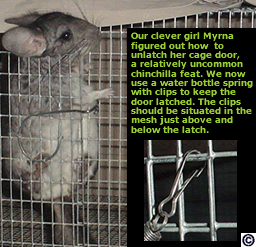
Once a chin has learned to do or to chew something, you cannot reverse or control that, they won’t “unlearn” or permanently give up something their mind or mouth has taken in. You can only make adjustments on your part to compensate for their ingenuity. For instance, a chin that’s learned to unlatch their cage door or reach new heights in a not-entirely-chin-proofed room cannot be counted on to reliably quit the behavior, it will be up to you to keep a latch on their cage door or to ensure that the room they play in is entirely chin-proofed.
Never physically chastise your chin as a deterrent to unwanted behavior! This approach will backfire. Do NOT use treats to train with, not unless you can limit it to one treat daily because chinchillas have sensitive digestive systems and are prone to a number of problems associated with excessive consumption of treats.
The TV Attraction
A LARGE cage to accommodate running and playing, a variety of chew toys, at least one hideaway per chin and a cage wheel will help decrease stress and boredom inside the cage while TV during waking hours will provide environmental stimulation when the chin isn’t actively engaged in out-of-cage exercise and interaction. If your chin is bored, high-strung, moody, or fur biting, TV can help. It reduces stress, helps desensitize high-strung chins, and provides a distraction that keeps their active, intelligent minds happily engaged and entertained, especially late at night when they’re wide awake and the chinparent is asleep. Distractions are also key to preventing cagemate conflicts.
We especially recommend TV to anyone who does chinchilla rescue work, it’s a useful aid when you’re not spending hands-on time with them. In our experience working with chins from many different adoption sources for many years, TV has been an indispensable tool in helping acclimate them to a new environment, it helps them relax so that they’re less nervous about change, less affected by stress, and things like thunderstorms, unfamiliar people stopping by or outside construction become less traumatizing. When we help ranch chinchillas adjust to pet life, they’re completely unaccustomed to the sights and sounds of a household at first and TV makes the transition more bearable. It just pulls them in and they get so enthralled with watching and listening to it that they don’t have time to dwell on their apprehensions.
TV also works wonders with chins who are fur biters or those with behavioral problems. Such characters often possess above-average intelligence and their self-mutilation (fur biting) or acting out is frequently attributable to sheer boredom, the tedium and stress of being locked up in their cage with NOTHING to see or do after the fun of exercise and playtime with their chinparent has ended and they must spend the remainder of the night alone. TV-watching provides environmental stimulation that relieves the stress caused when an intelligent animal is bored out of his mind.
A TV can be purchased inexpensively on eBay, at a yard sale, store sales or at your local thrift store, our chinkiddies currently have four so everyone gets a good view! TV-watching is especially good for giving your chin some company after you’ve gone to bed or are going out for the evening and they still have the better part of the night, their “day” ahead of them. If you take a vacation, leave the TV on, and let your pet sitter know that it’s keeping the chin company, in this case, be sure that the volume is kept lower than usual because your chin will be sleeping some of the time that you’re away.
In general, keep the volume on the low side, just enough to be adequately heard. The distance between the TV and the chin’s cage should be at least four feet due to the brightness but bear in mind that older chinchillas (which usually have diminished sight, if not cataracts, too) may need to be positioned at the four-foot distance just to be able to see the TV. Younger chins are just fine with a 5-7 foot distance from the TV screen. Programming should be relatively non-violent (anime’, cartoons and children’s shows; classic movie channels; nature, art, travel and history channels, etc.) and if possible, without commercial breaks or, “paid programming,” they really dislike that, much like people that way…
Anecdotes from our chins’ experience with “The TV Attraction!”
We kept our first chinkids in the living room, on the other side of the couch on the far wall where it would be cooler for them (right under the air conditioner). There were two chinnie pairs, the second was closer to the couch and had a better view of the TV, but this was before we knew what TV means to chins, before we fathomed the depth of the attraction… the fascination… the addiction…!
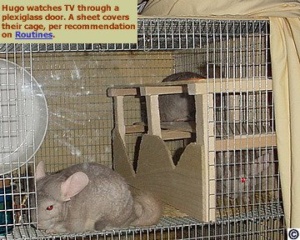
Deedlit was the first chin that really started noticing the exciting picture-n-sound box across the room. She would rest in her metal tube and watch “Howard’s End,” “A Room With A View” and other “girl” shows with me when my husband had long since passed out on the couch. You can tell they’re watching when they sit in an attentive pose when the show’s on and if they leave to get a snack or run on the wheel for commercial breaks and then return as soon as the show does.
Deedlit still watches the tear-jerkers with me, “Beaches,” the Robert Donat version of, “Goodbye, Mr. Chips,” and “Terms of Endearment”. We’ve seen the latter two about a dozen times in the past year (2004) alone, I know if she could express herself the human way that we’d be laughing or crying along together at the same parts as a couple of silly old biddies!
Chinchillas are capable of human speech recognition, and this was famously demonstrated for us by Hugo, our Trekkie fan. Once he heard his name called out on the TV by characters in a black and white adventure movie who were searching for their friend in the jungle. Hugo immediately stopped running on his wheel, ears perked up, and he raced to a top shelf and gave the characters his full attention, as if to say, “Here I am, it’s Hugo!!”
Hugo recognizes the voices of the Next Generation and Voyager casts (he’s watched them enough to know!). We know this because when the show returns from commercial break and the familiar voices are heard again, Hugo will drop whatever he was doing during the break to go back to his TV-watching seat. He is always intrigued by episodes he hasn’t seen, and we’ve observed that when the show is a repeat of one he’s seen before, he’ll watch it some and play some, not as attentive because, after all, he knows what’s going to happen!
Tamba is definitely our most demanding TV chin. He would prefer the TV to be left on always, but during sleeping hours our chinkiddies listen to soft music. If Tamba’s not ready for bed yet, he’ll sometimes bark to have the TV turned back on, then during waking hours, he barks for channel and volume change. Funny thing is, if he decides to sleep when the others are awake, he barks for the volume to be lowered, just for him! Tamba watches all shows with complete absorption, but especially the action-adventure movies. A true guy’s guy. He gets impatient with “Terms of Endearment” and really loathes British comedy, so mom has to remind him to share TV time with everyone else, especially since mom does like British comedy, and that usually placates his barking. If my husband ever builds a chin-proof remote, Tamba has first dibs!
I didn’t witness this incident myself, but my husband swears this really happened: we normally watch very mellow programming, but one particular night near the Halloween season the old horror flick “Poltergeist” was playing. There is an intense moment in the family backyard swimming pool where the wife falls in and a skeleton just pops up out of nowhere… all the chins were completely mesmerized and when the skeleton spooked the wife, Hugo was spooked too! He yelped and ran to the back of the cage and hid behind his log house! Of course, to everyone else’s dismay, after dad told mom she changed the channel to something different. Because Hugo’s reaction was to something specific in the course of the show, this indicates that chinchillas do recognize and relate to what they see on the TV in a more definite way than just acknowledging a blur of continuous sound, movement, and color.
Another example of their intelligence and perceptive abilities lies in the general consensus (at its peak, our rescue maintained between 30-40 chins from 2002-9) of approval for certain actors and shows, these are watched with great enthusiasm and full attention with no “channel change” barking: James Bond movies, John Wayne films, gangster movies, “Silent Sunday” on TCM, foreign films (the ears perk up upon hearing the language change) and children shows such as “Little Bear” and “Sesame Street.” After tuning in to early morning Noggin programming a few times in a row, the chins have recently decided that they like that routine and will now bark for their Noggin shows near daybreak. 2008 update: Noggin is now on 24 hours a day! The chinkids are ecstatic, that and TCM are now their main programs.
What this adds up to for us is the conviction that entertainment should be as much a part of a happy chin’s life as good feed and hay, chew toys, affection, and exercise. Since chins are capable of speech recognition (they learn their names and the names of their cagemates, too!) and exhibit complex thinking skills when understanding and relating to their chinparents, TV acts to stimulate and enrich their lives by bringing the whole world to them, in easy view from the cage. I have to say, I wouldn’t want to spend life in a cell with nothing of interest to watch or listen to. Sure, they probably won’t be replacing the great drama critics anytime soon, but then, when they finally do learn to SPEAK the language from watching all that TV, I don’t see why not!
Related Video: